
- Crane and rigging companies get construction leads from two pipes: bid invitations, where price usually decides, and inbound lift requests, which fewer rivals see.
- Eight hire-intent crane and rigging searches total about 32,500 US searches a month; six job and training searches total about 30,300 (Google Ads keyword data, August 2026).
- Top-of-page bids for hire-intent crane and rigging searches ran from about $1 to $20 in the US in August 2026, less than the $12.17 to $44.02 range on the search construction leads itself.
- Searches for construction leads peaked at 1,300 in October 2025, so fall is when owners and buyers plan work.
Construction leads mean two very different things to a crane and rigging company. A bid invitation asks you to price a project that several other subcontractors are also pricing. A lift request is a site superintendent calling because a rooftop unit has to go up on Thursday. Same label, different business.
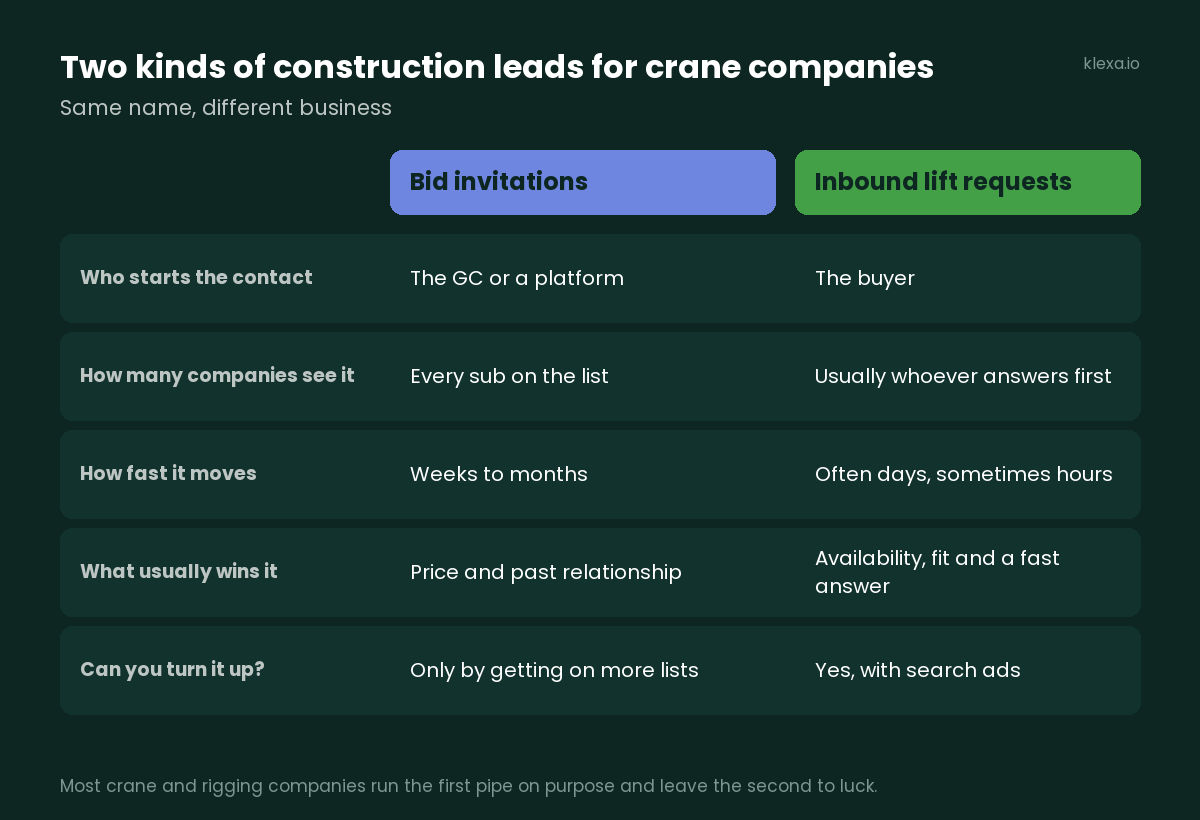
Here’s the short answer. Bid invitations, from general contractors, bid boards and project-lead databases, keep the schedule full of planned work, but price usually decides who wins. Inbound lift requests, mostly from people searching Google, are fewer and faster, fewer rivals see them, and they’re the only pipe you can turn up when the board has gaps. Most crane companies run the first on purpose and treat the second as luck.
Below: how the two compare, what crane buyers actually type into Google and what those clicks cost, why nearly half of all crane searches come from people who want a job rather than a lift, and how to tell a qualified lead from a time-waster.
Two kinds of construction leads, and which one you’re getting
A crane and rigging company is almost always a subcontractor. So most subcontractor leads reach you through someone else: a general contractor putting a project out to bid, an estimator who has you on a list, a platform that emails you an invitation to bid when a job in your area needs a crane.
That’s pipe one. Call it the bid pipe.
Pipe two starts with the buyer. A facility manager needs a chiller set. A machinery dealer needs a press moved. A GC’s project manager needs a 60-ton crane for a steel pick because the crane they booked fell through. They search, they find you, they call.
| Bid invitations | Inbound lift requests | |
|---|---|---|
| Who starts the contact | The GC or a platform | The buyer |
| How many companies see it | Every sub on the list | Usually whoever answers first |
| How fast it moves | Weeks to months | Often days, sometimes hours |
| What usually wins it | Price and past relationship | Availability, fit and a fast answer |
| Can you turn it up? | Only by getting on more lists | Yes, with search ads |
Swipe the table sideways to see every column.
Neither pipe is the “right” one. A healthy crane company runs both. The problem is running a single pipe without knowing it.
Bid invitations: bid lists, bid boards and construction lead services
The oldest source of construction leads is the bid list. A GC’s estimator keeps a list of crane and rigging subs, and when a job comes up, the invitations go out. Getting on those lists is relationship work: call the estimators, get pre-qualified, bid tight, show up when you said you would. Specialty subs on Reddit’s construction and estimating forums give the same advice. Nothing replaces it.
On top of that sit the platforms. Some are bid networks such as The Blue Book and BuildingConnected, where GCs find subs and send invitations. Others are project-lead databases, the construction lead services such as Dodge Construction Network and ConstructConnect, which track projects through preconstruction and hand you the plans, specs, bid dates and the names of who’s running the job. When an owner searches for Dodge construction leads or construction leads websites, this is usually what they’re weighing up.
What they’re good at is visibility on planned, larger commercial construction leads, early. If you want to be on a hospital or a warehouse before the steel package goes out, a database is how you find it.
The catch is built into the model. Every subscriber sees the same construction project leads. You’re one of many names on the same bid, and the work goes to whoever prices sharpest or already knows the GC. General contractor leads, the ones sold to GCs themselves, sit one step upstream of you. By the time a project reaches the crane package, the GC is shopping the number.
Pricing all those invitations costs estimator hours, too. An HVAC sub on the ContractorTalk forum described joining a bid network, getting more invitations than he could price, and still not winning one. He suspected too many contractors were “giving it away”.
That’s fine for planned work you’re set up to chase. It’s a poor fit for filling next Tuesday.
Inbound lift requests: what crane buyers actually type into Google
Here’s what the buyer side looks like in real numbers. These are average monthly US searches and Google’s top-of-page bid range, from Google Ads keyword data for August 2026.
| What the buyer searches | US searches / month | Top-of-page bid range |
|---|---|---|
| crane service | 12,100 | $3.70 to $18.37 |
| crane rental | 9,900 | $1.93 to $8.83 |
| crane rental near me | 3,600 | $2.24 to $10.94 |
| boom truck rental | 2,400 | $1.25 to $5.80 |
| rigging companies near me | 1,900 | $3.47 to $16.99 |
| rigging company | 1,000 | $3.59 to $15.39 |
| mobile crane rental | 1,000 | $1.95 to $7.58 |
| machinery movers | 590 | $3.83 to $20.03 |
Swipe the table sideways to see every column.
Two things stand out. First, a crane buyer’s click costs less than the click an owner makes when shopping for leads: the search “construction leads” itself carries a top-of-page range of $12.17 to $44.02. Second, the ranges are wide, and the top end sits on the searches that name a specific service. “Machinery movers”, “rigging companies near me” and “crane service” all reach $17 to $20, while “crane rental” and “boom truck rental” top out under $9.
Keep this in mind: these are national numbers. Inside one metro they shrink fast. In our look at why New York crane and rigging companies burn money on generic Google Ads, “crane rental” drew about 9,900 searches a month nationally and about 20 inside New York City. Small, local and valuable is the normal shape of this market.
Nearly half the crane searches are people looking for crane work
Now the other side of the same keywords.
| Search | US searches / month | Top-of-page bid range |
|---|---|---|
| crane operator salary | 14,800 | $0.80 to $5.42 |
| crane operator jobs | 8,100 | $0.08 to $0.89 |
| crane operator training | 3,600 | $0.83 to $3.95 |
| crane operator certification | 1,600 | $0.96 to $4.36 |
| rigging jobs | 1,300 | $0.09 to $0.73 |
| crane jobs | 880 | $0.08 to $1.18 |
Swipe the table sideways to see every column.
Add them up. The eight buyer searches above total about 32,500 a month. These six job and training searches total about 30,300. So for every person searching to hire a crane, there’s roughly another searching for crane work.
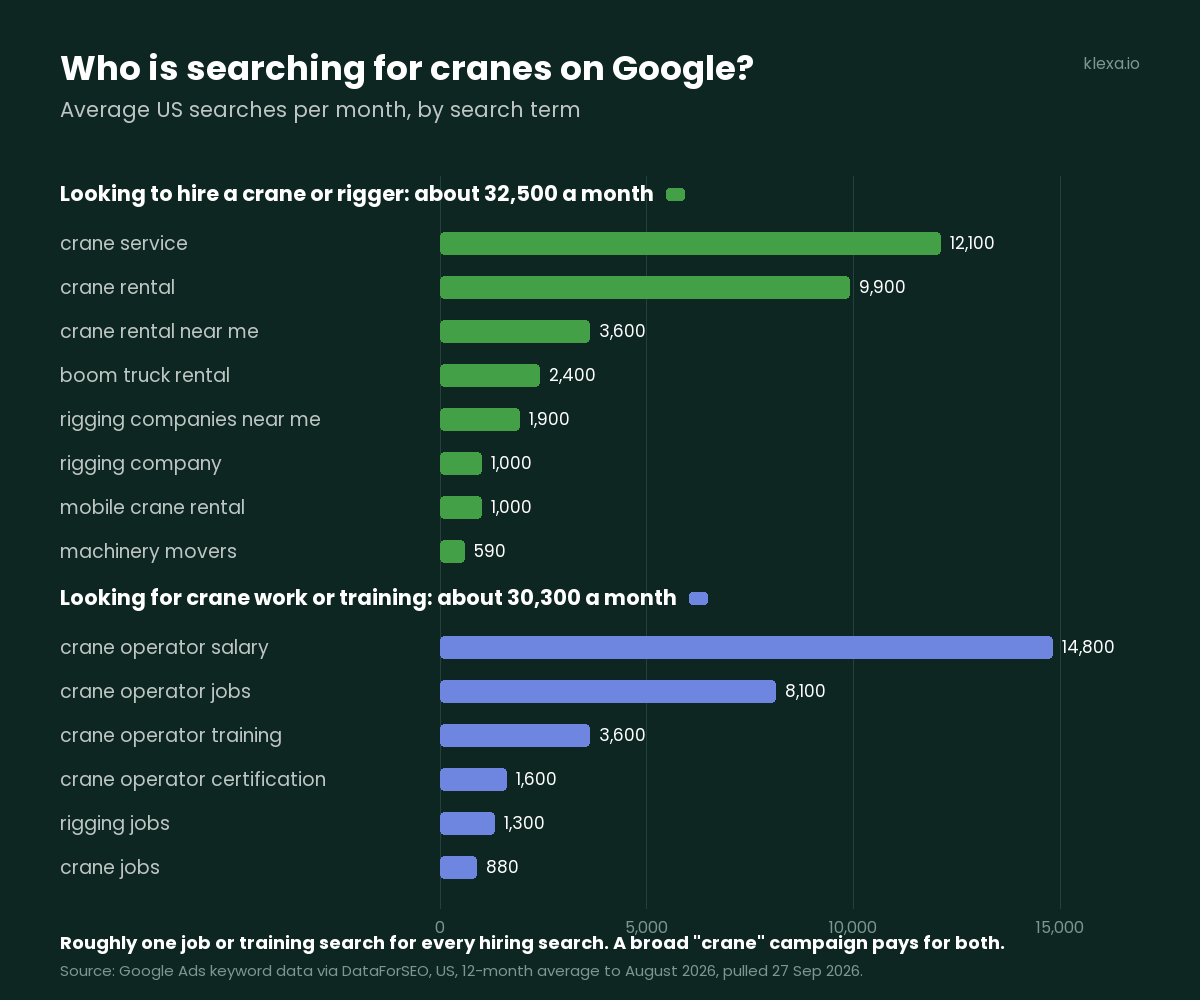
Look at the bids too. “Crane operator jobs” tops out under a dollar. Cheap clicks make a report look efficient. They don’t book lifts.
This shows up in real accounts. In July 2025 a crane rental company posted on Google’s own Google Ads Community forum that after advertising crane service for rent, people kept calling about jobs. The campaign was a Smart campaign, Google’s simplified automated type, which gives you little say over which searches show the ad. The Google Product Expert who answered suggested moving to a Search campaign, where you control the keywords, the ad copy and the negative keywords.
Add price researchers (“crane rental cost”, 590 a month; “how much does it cost to rent a crane”, 260) and homeowners pricing a hot tub delivery (“crane for hot tub”, 140), and you can see how construction lead generation on Google goes wrong. A broad campaign on the word “crane” can’t tell a site super from a job seeker. It serves both, and bills you for both.
Screening that out is mostly done with location settings and negative keywords. The idea is simple. Keeping it right every week is the work.
What a qualified construction lead looks like for a crane company
A lead isn’t a form fill or a ring. For a crane and rigging company, a qualified lead has five things.
- A site you serve. An address, or at least a town, inside the area you actually run trucks to. A contractor on ContractorTalk said a bid directory sent “a ton of leads”, many of them out of his area, and two jobs in two years he could trace back to it.
- Something to lift or move. Rough weight, what it is, where it’s going. “HVAC unit, roof of a three-story building” is a lead. “How much is a crane” isn’t yet.
- A date or a window. Even “sometime in November” tells you it’s real.
- The person who can say yes. A project manager, a super, an owner, a facility manager. Not someone gathering prices for somebody else.
- Work you want. Commercial picks, machinery moves, steel. If you don’t do hot tubs, a hot tub call isn’t a lead for you, however polite it was.
Hold every source to the same five. Bid invitations usually pass on paper. Inbound calls pass or fail in the first two minutes of the conversation.
Most inbound lift requests arrive as a phone call
People who need a pick this week don’t fill in long forms. They call. Often early, often from a job site, often while they’re doing three other things.
So the phone is where inbound construction leads are won or lost. If a superintendent calls at 7:10 in the morning and gets voicemail, they don’t leave a message and wait. They call the next company on the page. The ad did its job. The lead still went to someone else.
And answering isn’t just picking up. A ContractorTalk member put it bluntly: if you can’t give a ballpark over the phone, you often don’t get invited over. Whoever answers needs to know your availability and rough ranges, not just take a name.
Two fixes, both unglamorous. Make sure a person or a trained answering service picks up during working hours, including the early ones. And track calls so you know which search produced which call. A tool like CallRail ties each call back to the keyword and the ad, which is how you stop guessing.
When construction lead demand shows up
Timing matters more than most owners expect.
- Searches for “construction leads” itself peaked at 1,300 in October 2025 and fell to 480 by July and August 2026. Owners go shopping for work in the fall.
- “Mobile crane rental” ran 2,400 in September 2025 and 1,900 in October, against 390 in June and July 2026.
- “Crane lift service” hit 590 in October 2025. For most of spring 2026 it sat at 20.
- “Crane rental near me” peaked at 6,600 in February 2026.
The practical read: fall and late winter are when buyers plan and book. An account that’s only switched on when the board goes quiet is always a month late.
How to get construction leads you can trace to a won lift
Knowing how to get construction leads is half of it. The other half is knowing which ones turned into money.
An owner on Reddit’s marketing forum wrote about spending over $7,000 on marketing a construction business and feeling defeated. That feeling usually comes from spend nobody can trace to a job. So start plain. Tag every lead with its source the day it comes in: bid list, database, referral, Google search, repeat customer. After three months, look at won jobs, not leads. The source with the most leads is often not the one with the most revenue. If you’re setting a number for search, our guide to what a service business should spend on Google Ads walks through the math.
For Google Ads, tracing takes three connected pieces. Conversion tracking that counts calls and form fills properly (our guide to Google Ads conversion tracking covers the basics). Call tracking, so every call has a keyword attached. And a way to tell Google which of those calls became real jobs, usually through offline conversion imports, so the bidding learns from lifts instead of rings.
This is the part that’s easiest to skip. KLEXA sets up the measurement first and spends second, because a Google Ads account can only chase what it’s told to count. KLEXA also keeps crane rental, rigging, boom truck and machinery moving apart in the account, since each gets searched and priced differently. The exact build is the part we keep in-house. If you want to see how it applies to your trade, start with our page on Google Ads for contractors.
Two questions to ask about your own lead flow
Of the jobs you won last quarter, how many started as a bid invite and how many as a call you didn’t have to bid for? If you can’t answer, that’s the first fix. If it’s nearly all bids, you’re competing on price for most of your work.
When a search ad call came in before 8 a.m. last week, who answered it? If the honest answer is “nobody” or “I don’t know”, the ads may be working fine and the leads are leaking at the phone.
Klexa charges no management fee until the account books you a job. See how the pricing works.
Questions crane and rigging owners ask about construction leads
What are construction leads?
Any signal that someone may hire you for construction work. For a crane and rigging company that’s either an invitation to bid (from a GC, a bid board or a project database) or a direct request from someone who needs a lift or a move. They behave very differently, so track them separately.
Are free construction leads worth it for a crane company?
Sometimes, as a way onto bid lists. Free construction leads are usually public projects or free tiers of paid platforms, so many subs see the same job and the work is decided on price. Use them to find GCs to build relationships with, not as your main source of profitable work.
Are construction lead services like Dodge worth it for crane and rigging?
They can be, if you bid planned commercial work and have someone to chase it. A database like Dodge Construction Network shows you projects early and tells you who’s running them. It won’t bring you the urgent pick or the machinery move that never goes out to bid. Those come from search and from repeat customers.
How do subcontractors get commercial construction leads?
Three routes, and most crane companies need all three: get on general contractors’ bid lists and stay there, use a bid board or project database to find planned jobs early, and run search ads so that project managers and facility managers who need a crane now can find and call you directly.
What does a Google Ads lead cost a crane company?
It depends on your market and on how many clicks become real calls. Top-of-page bids for hire-intent crane and rigging searches ran from about $1 to $20 in the US in August 2026. One published example: KLEXA’s longest-running client, a New York crane and rigging company with KLEXA since 2021, has generated 496 tracked leads since 2024 at $197 each. That’s one account in one expensive market, not a promise.
Want a second pair of eyes on your lead flow?
KLEXA runs a Free Google Ads Audit for crane and rigging companies. We’ll look at your search terms, how calls are tracked and answered, and where the budget goes, and tell you plainly whether search ads can add work your bid lists don’t.