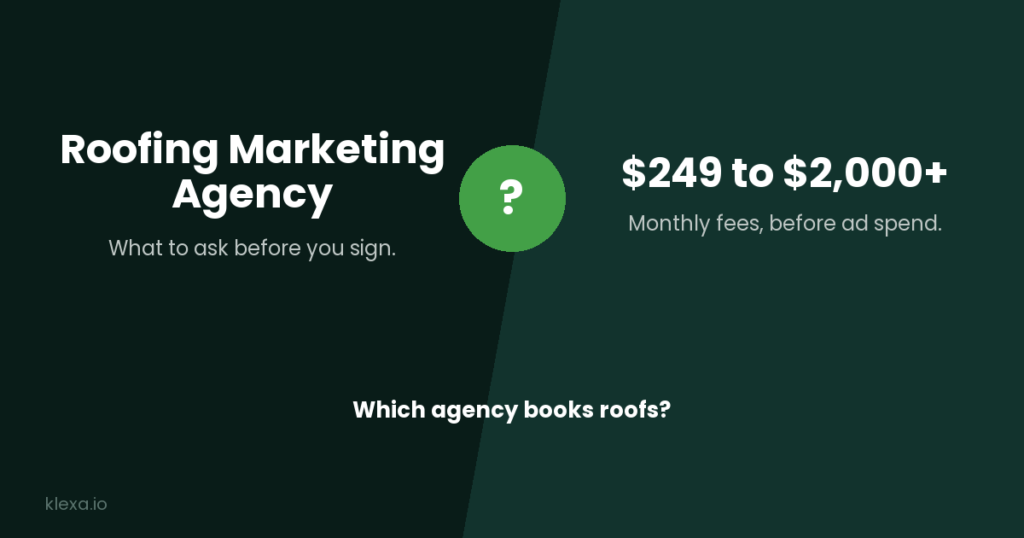
- Agencies bid $17.99 to $39.62 a click on Google to show up for “roofing marketing agency” (Google Ads keyword data, US, October 2026).
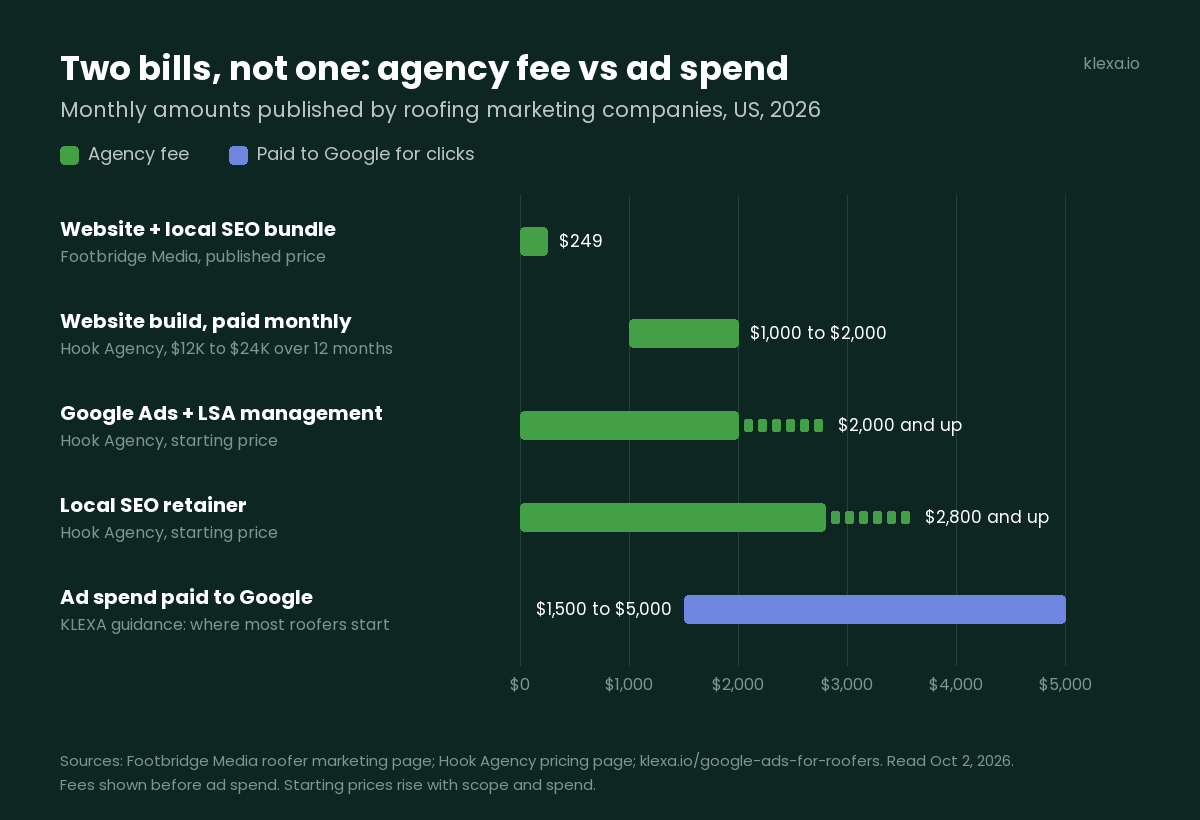
- Your bill has two parts: the agency fee and the ad spend paid to Google. Published fees run from a $249 a month website and SEO bundle to $2,000 a month and up for Google Ads management.
- Make sure you own the Google Ads account and the card on it, and put ownership and exit terms in the contract.
- Judge an agency at month three on cost per signed roof: agency fee plus ad spend, divided by roofs signed.
Here’s a number most roofers never see. To show up when you search “roofing marketing agency”, agencies bid $17.99 to $39.62 a click on Google. For “roofing marketing company” it’s $19.45 to $57.43 (Google Ads keyword data, US, pulled October 2026).
So the agencies calling you are paying good money to find you. That’s fine. It just means the sales call you’re about to sit through was expensive for them, and they’ll work hard to close it.
Here’s the other side of that call. What a roofing marketing agency should do, what it costs, the seven questions I’d ask before signing, and how to tell in 90 days whether it’s working.
What roofing marketing services should actually do for you
Strip away the logos and the slide decks. Roofing marketing has one job: get the phone ringing with homeowners who need a roof, in the area you serve, at a cost per signed job that still leaves you a profit.
Each service a roofing marketing agency sells is a way to do that. Google Ads puts you at the top of search today. Google’s Local Services Ads (LSAs) give you the Google Guaranteed badge and charge per lead. Your Google Business Profile wins the map. SEO earns rankings over months. The website or landing page turns all that traffic into calls.
That last part matters more than most roofers think. Google grades your ads partly on the page they send people to, through a score called Quality Score, so a better page can make the same click cheaper.
The catch is the word “lead”. To an agency, a lead is often any call or form. A 9-second hang-up counts. So does a shingle salesman, a job seeker, and a homeowner two states over.
Bought leads can be worse. One contractor on the ContractorTalk forum said that on a $500-a-month lead plan, about three of every four leads came with phone numbers that didn’t work. That’s one company’s experience, not a statistic, but it’s a common story.
To you, a lead is a homeowner who wants a quote, in your service area, for work you do. Good marketing for roofers is measured against your definition, not theirs. Hold onto that. It comes up again in the questions below.
And not all real leads are equal. A $900 leak repair and a $15,000 replacement can come from the same search box. A roofing marketing agency that knows the trade splits them into separate campaigns and budgets, because a replacement can justify a lead cost that would sink a repair.
The five kinds of roofing marketing companies, and the catch with each
Not every roofing marketing company is the same kind of business. “Digital marketing for roofers” can mean a website shop, an SEO firm, a paid-search team or a lead broker. Before you compare prices, figure out which kind you’re talking to. Each one is good at something, and each one has a catch.
| Type | What you get | The catch |
|---|---|---|
| Full-service roofer marketing agency | Website, SEO, Google Ads, reviews, sometimes video, under one roof | You pay for every service in the bundle, and the weakest one can hide behind the strongest |
| Generalist digital agency | Polished reporting, big teams, many industries | You’ll spend the first months teaching them the difference between a repair lead and a replacement lead |
| Google Ads specialist | Search campaigns, tracking, and landing-page advice, managed by people who only do paid search | They won’t build your website or film your crew, so you’ll need someone else for that |
| Low-cost website and SEO bundle | A site, local SEO and a CRM for a flat monthly fee | Paid ads and ad spend usually aren’t in the headline price |
| Pay-per-lead seller | Leads delivered without running any ads yourself | The same homeowner is often sold to several roofers, and you build nothing you own |
Swipe the table sideways to see every column.
Which row fits depends on where you are. If you have no website worth sending traffic to, a bundle or a full-service roofing marketing agency makes sense first. If the site works and you need more calls this month, paid search is the faster lever.
KLEXA sits in the third row. KLEXA runs Google Ads for roofers and other trades, and that’s the whole focus. The catch is real: if you want yard signs, video or a new website, that’s not us.
If you want named firms rather than types, we’ve ranked them in our guide to the best Google Ads agencies for roofing contractors, with the catch on every one.
What a roofing marketing agency costs in 2026
A roofing marketing agency bill has two parts, and a lot of quotes blur them together. The first is the agency’s fee. The second is ad spend, the money that goes to Google for clicks.
Here’s what some agencies publish on their own websites:
| Source | What they publish | Ad spend included? |
|---|---|---|
| Footbridge Media (roofer page) | $249 a month for website, local SEO, content, reviews and CRM, no contract | No paid ads in the listed bundle |
| Hook Agency (pricing page) | Google Ads and LSA management from $2,000 a month, scaling with ad spend | No |
| Hook Agency (pricing page) | Local SEO from $2,800 a month | Not applicable |
| Hook Agency (pricing page) | Websites at $12,000 to $24,000, split over 12 months | Not applicable |
Swipe the table sideways to see every column.
Then add the clicks. KLEXA’s own guidance on our Google Ads for roofers page is that most roofers start with $1,500 to $5,000 a month in ad spend. Hire-intent roofing clicks run roughly $15 to $85 at the top of the page, which we broke down in the roofing PPC guide.
One more cost hides in the setup. Some agencies charge a one-time onboarding or build fee for tracking, landing pages and campaign structure. Ask for it in writing, because it’s often where the first month’s budget goes.
So a realistic paid-search setup is a management fee plus a few thousand a month in clicks. A $249 website plan and a $2,000 ads plan aren’t cheaper and dearer versions of the same thing. They’re different jobs.
For the full picture of marketing for roofing companies, including LSAs and SEO, see what roofing marketing actually costs, and size your spend with the Google Ads budget calculator.
Seven questions to ask before you sign
These work on any roofing marketing agency, including us. Ask them on the sales call and write down the answers. Vague answers are answers too.
- Who owns the Google Ads account, and whose card is on it? It should be your account, your login, your card, with the agency linked in as a manager through its manager account. Google’s own community experts point out that whoever pays Google is usually treated as the owner. Put ownership in the contract, because otherwise the history Google learned from your money can leave with them.
- What counts as a lead in your reports? Ask for the minimum call length they count and whether spam forms are removed. Then ask how they’ll tell a repair lead from a replacement lead.
- How do you track a call all the way to a signed job? Good answers mention call tracking, recorded calls, your CRM, and sending your closed jobs back into Google Ads so it learns which clicks became roofs. That last step is called an offline conversion import, and it’s what lets Smart Bidding chase signed jobs instead of phone calls.
- Who actually works on my account, and who writes the ads? Not who sold it. Ask for the name and title of the person making changes each week, and ask to approve ad copy before it runs. Contractors on ContractorTalk complain about outsourced marketing written by people far removed from the business.
- How long is the contract, and how do I leave? Month-to-month is common now. If it’s 12 months, ask what happens to your account, tracking and website on day one after you cancel, and whether there’s an exit fee.
- How is your fee set? Flat, a percentage of ad spend, or both? A percentage fee rises every time you raise the budget, even when the work doesn’t change.
- Can I see a real report from a current client, names removed? You’re looking for calls, booked inspections and cost per lead. If the report leads with impressions and click-through rate, you know what they optimize for.
Good roofing contractor marketing agencies answer all seven without flinching. A few will even push back on your budget if it’s too small to test properly. That’s a good sign.
Red flags that mean you’re paying for clicks, not roofs
Most bad matches with a roofing marketing agency show warning signs in the first month. You just have to know where to look.
- Reports full of impressions, clicks and “reach”. Those measure activity. They don’t measure roofs.
- Guaranteed lead numbers. Nobody controls Google’s auction or your phone answering. A guarantee usually means “lead” has been defined loosely.
- The agency owns the account or the website. Leaving gets expensive, which is the point. The Google Ads Community forum has thread after thread from business owners locked out of accounts they paid for, some facing a cancellation fee to get access back.
- A 12-month lock-in before you’ve seen a single result.
- No call recordings. Without them, nobody can tell you which “leads” were a homeowner and which were a robocall.
- Leads that other roofers also got. Shared leads turn every quote into a race to call first.
If a marketing agency for roofers can’t explain how they’d catch these problems in your account, they probably won’t catch them.
How to tell if your agency is working: the first 90 days
Most advice on how to market a roofing company stops at “hire someone good”. The harder part is checking, month by month, that the roofing marketing agency you picked is earning its fee.
You don’t need to read Google Ads to judge an agency. You need four numbers and a calendar: leads, booked inspections, signed roofs, and total spend.
Weeks 1 to 2. Tracking goes in before money goes out. Every call and form should be counted, and you should be able to hear the calls. First leads often show up in this window, because search ads reach people who are already looking.
Weeks 4 to 6. Google’s learning phase settles once it has real conversion data. Cost per lead should start to steady. Wild swings here are normal. Wild swings with no explanation aren’t.
SEO runs on a longer clock. Rankings take months, so don’t judge an SEO retainer on 60 days the way you’d judge paid search. Ask the agency up front which clock each service is on.
Month 3. Now judge it on cost per signed roof, the one number that matters in roofing company marketing:
Cost per signed roof = (agency fee + ad spend) ÷ roofs signed from those leads
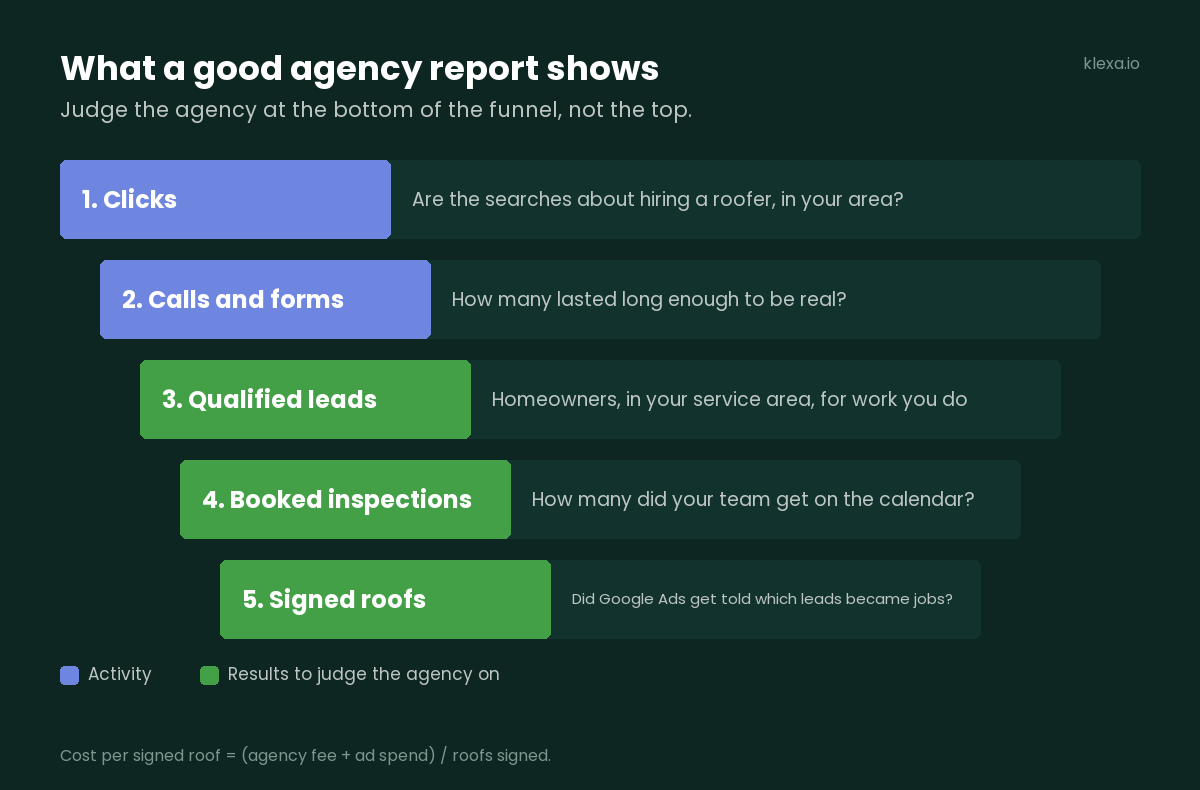
Here’s a worked example with made-up numbers, not a benchmark. Say you pay a $1,000 fee and $3,000 in ad spend. That brings 30 real leads, 12 booked inspections, and 3 signed replacements. Your cost per signed roof is $4,000 ÷ 3, about $1,333.
Is that good? Only you know. Compare it with your profit on a replacement. If one signed roof clears several thousand dollars, you’re winning. If it doesn’t, the fix might be the ads, the close rate, or the phone. A good agency will help you work out which.
One warning about that last one. If calls go to voicemail during the day, no roofing marketing agency can fix your numbers. Listen to ten recorded calls before you blame the ads. It takes twenty minutes and it settles a lot of arguments.
Storm season changes the math. After hail, search demand jumps and so do click prices, because every roofer in town switches on at once. Ask your agency what they do in a storm week before the storm, not during it.
Running a roofing company? See our roofing marketing offer: Google Ads with no setup cost and no management fee until your first booked call. For organic rankings and the map results, see SEO for roofers.
Questions roofers ask about hiring a roofing marketing company
How much should a roofer pay a roofing marketing agency?
Published fees range from a $249 a month website and SEO bundle to $2,000 a month and up for Google Ads management, before ad spend. What matters is your cost per signed roof, not the fee on its own.
What is the best marketing for roofing companies?
The channel that reaches homeowners already looking for a roofer, in your area, and that you can track to signed jobs. For most roofers that starts with Google Ads, Local Services Ads and a strong Google Business Profile, with SEO building alongside.
Is roofing digital marketing worth it for a small roofing company?
It can be, if the budget is big enough to test and every lead is tracked. Start narrow: your best service, your core service area, and a phone that gets answered.
How long before a new agency brings leads?
Paid search often brings first calls within one to two weeks. Cost per lead usually settles after four to six weeks. SEO takes months.
Should I buy leads instead of hiring an agency?
Bought leads are fast but often shared, and you own nothing when you stop paying. An agency running your own ads builds an account, data and a brand you keep. Our guide on how to get roofing leads runs the numbers on both.
Want a second pair of eyes before you sign?
KLEXA runs a Free Google Ads Audit for roofers. If you already run ads, we’ll show you where the budget leaks. If you’re weighing a roofing marketing agency proposal, bring it along and we’ll tell you what we’d ask them, whether or not you hire us.