
- US searches for data center construction rose from 2,400 in September 2025 to 4,400 in August 2026, while data center jobs searches rose from 9,900 to 27,100 (Google Ads keyword data).
- On a data center job the crane is hired by the general contractor, the electrical and mechanical subcontractors, or equipment and module suppliers, each for different lifts.
- Many large data center contractors prequalify subs through platforms like ISNetworld, Avetta or Veriforce before a lift is ever scheduled.
- Searches like data center crane have too little volume for Google to report, so ads should target the lift and the landing page should sell the data center experience.
Data center construction is where a lot of the heavy picks are right now. Transformers, switchgear, backup generators, chillers, structural steel, prefabricated data halls set by crane. If you run a crane and rigging company, you’ve probably heard some version of “you should be getting data center work”.
Here’s the short answer. Most of those lifts never start with a Google search. They go to crane companies already on the general contractor’s list, or the electrical sub’s, or the mechanical sub’s. Google Ads can’t buy you onto those lists. What it can do is put you in front of the project manager who needs a pick moved up to Thursday, and send them to a page that proves you can handle it.
So this piece covers both: who actually hires the crane on these jobs, how to get on their lists, what they type into Google, and why an ad that says “data center” mostly gets you job seekers.
Data center construction searches are up, and so are the wrong ones
The demand is real, and you can see it in Google’s own numbers. Here’s how a few US searches moved between September 2025 and August 2026, from Google Ads keyword data.
| Search | Sep 2025 | Aug 2026 |
|---|---|---|
| data center construction | 2,400 | 4,400 |
| ai data center construction | 90 | 390 |
| hyperscale data center construction | 10 | 590 |
| data center construction jobs | 390 | 2,400 |
| data center electrician jobs | 260 | 2,900 |
| data center jobs | 9,900 | 27,100 |
Swipe the table sideways to see every column.
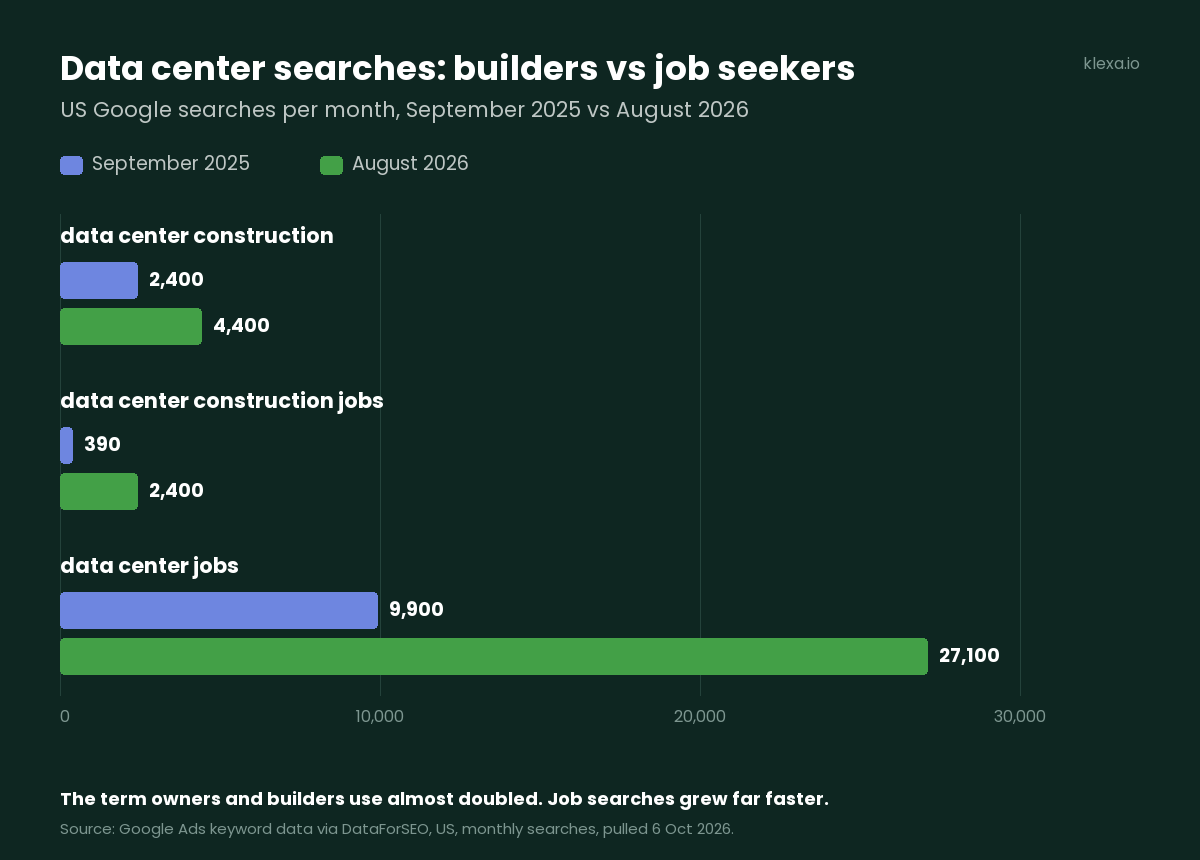
Read the bottom half of that table twice. The fastest growth isn’t from people who want to build data centers. It’s from people who want to work on them.
That’s good news when you’re hiring crane operators and riggers. It’s bad news for your ad budget, and we’ll come back to it.
Who hires the crane on a data center construction job
A data center isn’t one customer. It’s a stack of them, and each one buys lifts for a different reason.
| Who calls you | What they usually need lifted | What they check first |
|---|---|---|
| The general contractor | Steel, precast, roof equipment, general picks | Safety record, insurance, crane and crew availability |
| The electrical subcontractor | Transformers, switchgear, generators, UPS and battery cabinets | Lift plans, rigging for heavy top-heavy gear, set dates that match deliveries |
| The mechanical subcontractor | Chillers, cooling towers, air handlers, rooftop units | Reach, capacity, and working around other trades |
| Equipment vendors and modular suppliers | Prefabricated power and cooling modules delivered set-ready | Can you meet the truck on the day it lands |
| The owner’s rep | Rarely hires direct, but asks who’s on the job | Your name coming up as reliable |
Swipe the table sideways to see every column.
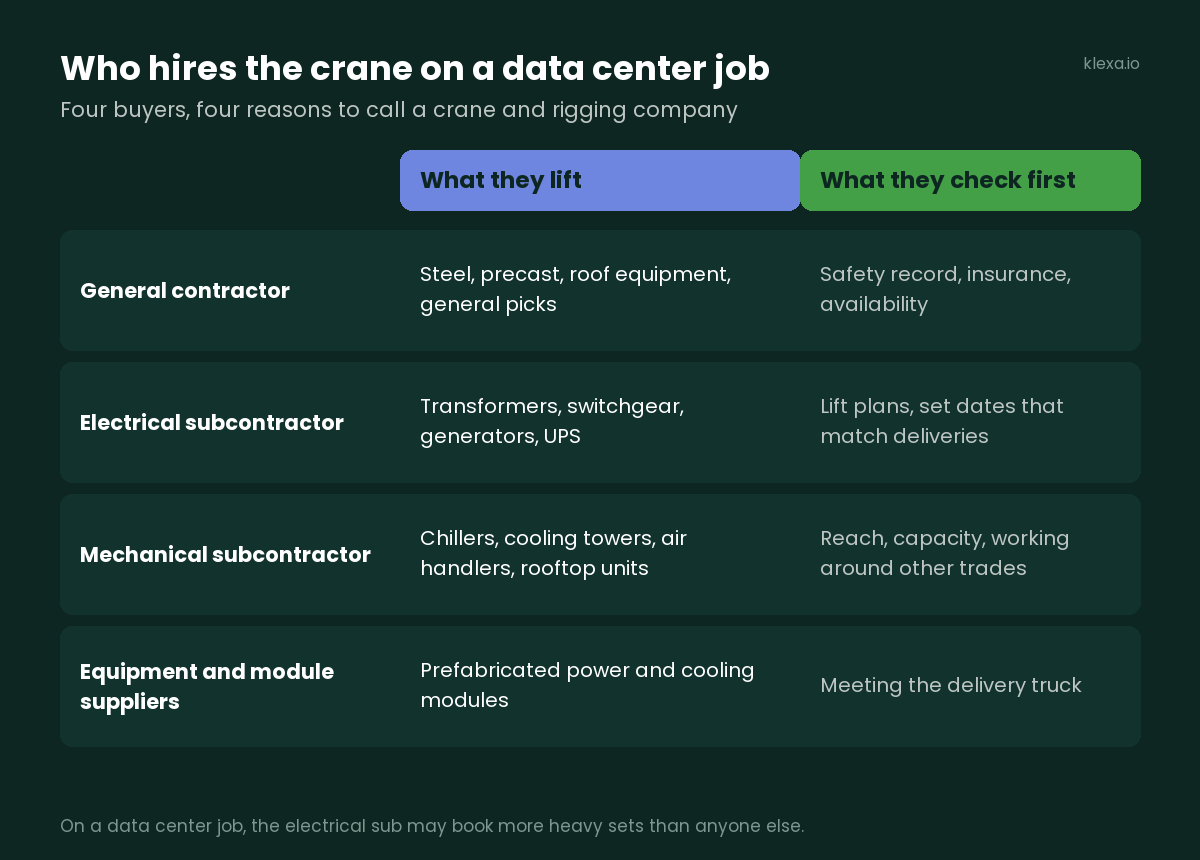
The general contractors here are the big data center builders. Search “data center construction companies” and you’ll get their service pages, plus lists ranking the top data center construction companies. Those lists are, quite literally, your customer list. Every data center construction company on them subs out picks to someone.
But for a lot of crane and rigging companies the better door is one level down. On a data center job the electrical sub may have more heavy sets than anyone else on site, and they’re often the ones booking the crane.
The stakes are high on these picks. One operator on Reddit’s crane forum, who runs a large crawler crane on data center jobs, asked other operators whether they should have made a particular lift at all. On gear this expensive, that question gets asked before the pick, not after.
That’s why the data center construction cost that keeps a buyer up at night isn’t your day rate. It’s a delay, or a damaged transformer. When a unit sits on a trailer because the crane didn’t show, the whole construction schedule behind it slips. So reliability, not just price, wins this work.
Get on the list before the lift exists
Data center contractors pick their subs before a lift is ever scheduled. By the time a project manager calls, the shortlist was usually built months ago, often inside a prequalification portal.
Expect to be asked for most of this:
- A profile on a contractor prequalification platform such as ISNetworld, Avetta or Veriforce (the system formerly known as PEC). Many large data center general contractors manage subs through one of them.
- Your EMR, the experience modification rate on your workers’ comp. Under 1.0 is the usual bar.
- OSHA logs, a written safety program, and a drug and alcohol program.
- Insurance certificates with limits that fit a large commercial job.
- NCCCO-certified operators, plus riggers and signal persons with paperwork to match.
- Engineered lift plans for critical picks, not a sketch on the back of a ticket.
Fair warning: these portals cost a yearly subscription and a real chunk of office time. Contractors on Reddit’s safety and small business forums complain about the fees and the paperwork in the same breath. So join the ones your target GCs and subs actually use, not every portal that emails you.
None of that is marketing, exactly. But it decides whether your marketing ever gets a chance.
So start with a list. Write down the data center construction projects within reach of your yard, then who’s building each one: the GC, and the electrical and mechanical subs. From outside it’s surprisingly hard to tell. The top Google result for “data center construction companies” is a Reddit thread of civil engineers asking exactly that.
Then do the slow part. Call their estimators, get prequalified, and show up when you said you would. If you want the bigger picture on bid lists versus inbound requests, our guide to construction leads for crane and rigging companies breaks down the two pipes.
What project managers type when they need a pick
Now the Google side. When a PM on a data center job needs a crane, what do they search?
Not “data center crane”. That phrase, along with “data center rigging services”, “generator rigging services” and “chiller rigging”, draws too few searches for Google to report a number at all. People search for the lift, not the building type.
| What buyers search | US searches / month | Top-of-page bid range |
|---|---|---|
| crane service | 12,100 | $3.70 to $18.37 |
| crane rental | 9,900 | $1.93 to $8.83 |
| heavy haul | 3,600 | $3.45 to $11.00 |
| equipment rigging | 2,900 | $0.71 to $6.00 |
| mobile crane rental | 1,000 | $1.95 to $7.58 |
| machinery movers | 590 | $3.83 to $20.03 |
| industrial rigging | 260 | $3.07 to $15.59 |
| crawler crane rental | 260 | $1.88 to $9.07 |
Swipe the table sideways to see every column.
Those figures are Google Ads keyword data for the US, August 2026.
So the job splits in two. The ad targets the lift. The page it lands on sells your data center experience.
Keep in mind these are national numbers, and they shrink fast inside one metro. In our look at why New York crane and rigging companies burn money on generic Google Ads, “crane rental” drew about 9,900 searches a month nationally and about 20 inside New York City. Small, local and valuable is normal for this trade.
Why “data center” in your ads mostly buys job seekers
Go back to that first table. “Data center jobs” went from 9,900 to 27,100 searches a month in a year. “Data center construction jobs” grew about six times. Even Google’s results for crane and rigging data center work are crowded with rigging superintendent job ads.
Put “data center” into a broad match campaign and Google will happily show your ad to all of them. Job seekers click. Some of them call. Every one of those clicks is paid for.
This already happens with plain crane ads. A crane rental owner posted on Google’s own Google Ads Community forum that after advertising crane service for rent, people kept calling about jobs. The campaign was a Smart campaign, which gives you little say over which searches trigger the ad, and the Google Product Expert who answered suggested moving to a Search campaign with real keyword control.
That’s not a reason to avoid the topic. It’s a reason to keep the words “data center” on your landing page, where they help, and out of your loose keywords, where they cost you. The screen is mostly negative keywords and location settings, checked every week, because new job phrases keep turning up in the search terms report.
KLEXA keeps hire-intent searches apart from job and training searches for exactly this reason. The example on our homepage is a real one: “free crane rental” excluded, “crane rental brooklyn” kept.
Build one page a data center PM can say yes to
Most crane websites have a home page, a fleet page and a contact form. A PM on a data center job needs more than that before they’ll pick up the phone.
What belongs on a data center page:
- The heavy equipment you actually set on these jobs: transformers, switchgear, generators, chillers, steel, rooftop units.
- Your capacity range, and what you bring for tight sites and indoor work, like mini cranes, floor protection and crane mats.
- Modules. Modular data center construction means power and cooling skids show up ready to set, often on a tight delivery window. Say plainly that you can meet the truck.
- Your prequalification IDs, EMR and safety numbers, right on the page, not in a PDF somebody has to request.
- How you plan lifts, and who signs off. Even crane people on Reddit ask what a day-to-day lift plan process looks like, so show yours.
- How you bill overtime, travel and standby. Buyers trade warnings about surprise overtime charges, and a clear answer up front removes one reason to call someone else.
- Photos of real jobs, with the GC’s permission.
- A phone number that gets answered at 6 a.m.
That last one matters more than it looks. The PM who calls at 6:40 and gets voicemail calls the next company. The ad did its job, and the lift still went somewhere else.
Aim at where the data center projects are
Data center projects don’t spread evenly. They cluster in a handful of counties near big power and fiber, and those campuses can keep going for years.
That changes how you advertise. Instead of one wide circle around your yard, you can put tighter location targets around the counties where the work is. Upcoming data center projects usually show up early in county planning agendas and local news, long before steel goes up, so you can be visible before the lifts start.
Then track it. Every call from an ad should carry the keyword that produced it. A tool like CallRail does that, and proper Google Ads conversion tracking, with offline conversion imports, tells Google which calls turned into real lifts. KLEXA sets up that measurement before spending a dollar on clicks, because an account can only learn from what it counts. The exact build stays in-house. If you want to see how it applies to your trade, start with our page on Google Ads for contractors.
Two questions to ask about your own setup
If a project manager on a data center job landed on your website today, could they find your prequalification IDs, your lift range and your safety numbers in under a minute? If not, that’s the first fix, and it costs nothing in ad spend.
Of last month’s ad calls, how many were from people looking for a job? If you don’t know, your search terms report does. It’s usually more than owners expect.
Running a crane or rigging company? See how we run Google Ads for crane and rigging companies. Klexa charges no management fee until the account books you a job.
Questions crane and rigging owners ask about data center construction
Is data center construction worth chasing for a smaller crane company?
Often, yes, though not always as the lead crane. Smaller fleets do well on the electrical and mechanical scopes: setting gear, rooftop units, indoor picks with mini cranes. Get prequalified with those subs, not just the general contractor.
How do crane companies get on data center contractors’ bid lists?
Prequalify first. Many large data center contractors want a profile on a platform like ISNetworld, Avetta or Veriforce, an EMR under 1.0, current insurance and certified operators. Then call their estimators and ask what work is coming up.
Should I advertise “data center crane” on Google?
Not as a keyword. Too few people search it for Google to report a number. Advertise the lift people search for, like crane service, heavy haul or industrial rigging, and send those clicks to a page about your data center work.
Which data center construction companies hire cranes?
All of them, through someone. The general contractors that build data centers hire cranes for steel and general picks. Their electrical and mechanical subcontractors often book the heavy equipment sets. On each project, ask who owns the lifts.
What does a Google Ads click cost for crane and rigging work?
Top-of-page bids for searches like crane service, heavy haul and industrial rigging ran from under $1 to about $20 in the US in August 2026. What a lead costs depends on your market and how many clicks turn into real calls.
Want a second look before you chase data center work?
KLEXA runs a Free Google Ads Audit for crane and rigging companies. We’ll look at your search terms, your landing page and how calls get answered, and tell you plainly whether search ads can help you land data center lifts.