
TL;DR: Winter plumbing ads should be built by early December: frozen pipes searches rose from 1,900 in October 2025 to 40,500 in January 2026. Water heater replacement searches peak in October, so replacement ads belong in October. Hire-intent plumbing clicks run roughly $7 to $114 at the top of the page (US, September 2026).
- Frozen pipes searches rose from 1,900 in October 2025 to 40,500 in January 2026, so freeze campaigns need to be built by early December.
- Water heater replacement searches peaked at 74,000 in October 2025, so replacement ads belong in October, not December.
- Hire-intent plumbing clicks run roughly $7 to $114 at the top of the page (US, September 2026); searches like water heater cost and plumber jobs are far cheaper and rarely book work.
- Google is moving Local Services Ads into Google Ads, with plumbing in the first US phase; old LSA reports do not carry over, so export them first.
In October 2025, about 1,900 people a month searched Google for “frozen pipes”. By January 2026 it was 40,500. Frozen-pipe demand rose twentyfold in three months, and most of it lands in a couple of cold snaps. If your plumbing advertising for winter starts the morning the pipes freeze, you’re setting it up during the most expensive week of the year.
Here’s the plain answer. The winter plumbing advertising that books jobs is Google Search ads on searches that mean “I need a plumber now” or “I’m ready to replace my water heater”, live before the cold arrives, with every call traced back to the ad that produced it. Facebook, mailers and billboards come after that, and they do a different job.
Below: when winter plumbing searches really peak, what those clicks cost on Google right now, the Google Local Services Ads migration that affects every plumbing business this season, and where winter budgets usually leak.
The short version: where plumbing advertising money goes this winter
One budget, a few weeks to plan. Spend it in this order.
- Google Search ads on hire-intent searches. Burst pipe, frozen pipe repair, no hot water, water heater replacement, emergency plumber. These people already have the problem. Search catches emergency plumbing demand that already exists.
- Google Local Services Ads (LSAs), if you qualify. You pay per lead, not per click, and they sit above the regular ads on Google Search and Google Maps. How many leads you get depends on how Google ranks you there, so they sit beside search, not in place of it. We compared the two in Google Ads vs Local Services Ads.
- Retargeting and Facebook for past customers. Good for a “winterize your pipes” reminder. Weak at catching a burst pipe.
- Mailers, wraps and billboards last. They build a name in the neighborhoods you serve. They won’t tell you which job they produced.
Most plumber advertising guides online list a dozen channels as if they were equal. They aren’t. Search goes first for one reason: it’s the only channel where the customer tells you what’s wrong before you pay for the click. It comes with a condition, though. One owner on the PlumbingZone forum put Google first “unequivocally”, then added that it has to be customized and monitored constantly, “not when you see Google has cleaned out your bank account.” That’s the right order of thinking.
It also beats the lead-seller model many plumbers start with. A complaint that comes up on plumbing forums is paying for leads you didn’t win, or finding out five other plumbers got the same one. With your own search ads, the call comes to you.
Local Services Ads are moving into Google Ads, and plumbing is in the first wave
This migration matters for your plumbing advertising plan for the winter. Google’s Ads Help Center says Local Services Ads are moving into Google Ads as Performance Max campaigns with pay-per-lead goals. The first US phase started in August 2026 with select home and storefront service advertisers, and plumbing is named in that group. Service-area businesses without a storefront, which is most plumbing shops, follow in late 2026.
What Google says stays the same: you still pay only for valid leads, and the ads show in the same spots on Google Search and Google Maps. What changes: the separate LSA dashboard goes away and your old LSA performance reports don’t carry over. Weekly budgets become daily ones (the weekly figure divided by 7). Manual bidding, such as a maximum cost per lead, is no longer supported. Google also says to allow up to two weeks after migration for performance to settle.
So export your LSA reports now. And if your account moves during a cold snap, don’t judge lead volume in those first two weeks.
When winter plumbing searches actually peak
“Start your winter ads early” is easy advice. It helps to see the curve.
This is Google Ads keyword data, pulled through DataForSEO for the whole United States in September 2026, month by month:
| Search | Oct 2025 | Dec 2025 | Jan 2026 | Feb 2026 | Jun 2026 |
|---|---|---|---|---|---|
| frozen pipes | 1,900 | 9,900 | 40,500 | 22,200 | 1,000 |
| burst pipe | 1,300 | 2,400 | 6,600 | 5,400 | 1,600 |
| 24 hour plumber | 4,400 | 9,900 | 9,900 | 18,100 | 8,100 |
| water heater replacement | 74,000 | 60,500 | 49,500 | 33,100 | 33,100 |
Swipe the table sideways to see every column.
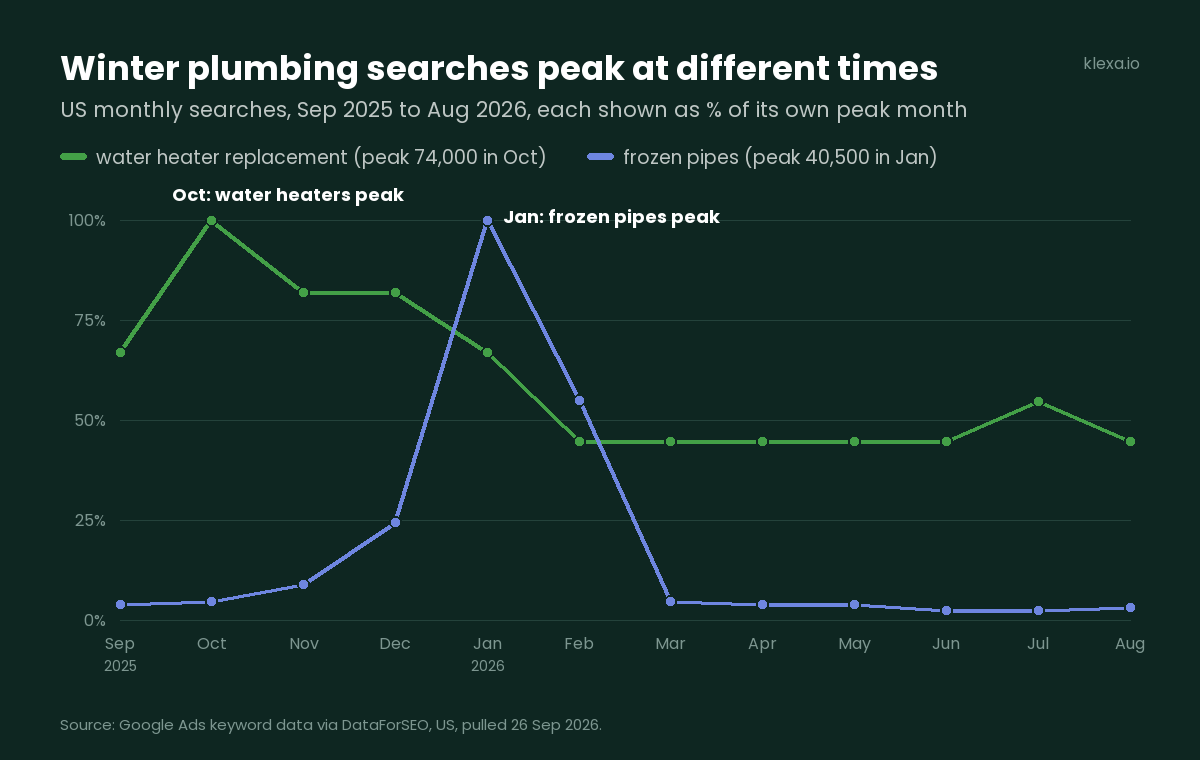
Three things stand out.
Water heater replacement peaks first, in October, then slides all winter. One likely reason: colder incoming water makes an old tank work harder, and the ones that were already failing give out. Either way, those buyers are shopping before the holidays.
Frozen pipes arrive late and all at once. December is five times October. January is four times December. Then it’s gone by March.
And “24 hour plumber” kept climbing into February 2026, to 18,100. The after-hours calls outlast the coldest month, probably because a pipe that froze in January often doesn’t show its crack until it thaws.
So the calendar for plumbing advertising in winter looks like this: water heater ads first, emergency and frozen-pipe ads built and ready by December, after-hours coverage through February. One more reason to start early. A new Google Ads campaign spends its first weeks learning who converts. Launch it during a cold snap and it’s learning on your most expensive days.
What winter plumbing clicks cost on Google
Before you put a winter number on plumbing advertising, look at the clicks. These are Google’s top-of-page bid ranges for the US, September 2026. The low end is roughly what it takes to show near the top on a quiet day. The high end is what the most aggressive advertisers pay.
| What the homeowner searches | Avg. US searches / month | Top-of-page bid range |
|---|---|---|
| emergency plumber | 74,000 | $24.65 to $114.39 |
| 24 hour plumber | 8,100 | $25.57 to $99.15 |
| water heater repair | 74,000 | $18.22 to $85.92 |
| plumber near me | 823,000 | $12.04 to $81.91 |
| burst pipe repair | 1,600 | $15.21 to $80.00 |
| clogged drain | 9,900 | $12.80 to $74.48 |
| sewer line repair | 18,100 | $10.28 to $67.36 |
| frozen pipe repair | 390 | $28.24 to $66.89 |
| water heater replacement | 49,500 | $7.15 to $55.90 |
| drain cleaning | 110,000 | $4.72 to $51.15 |
| frozen pipes | 8,100 | $0.77 to $29.26 |
| water heater cost | 9,900 | $0.94 to $10.27 |
| plumbing supply near me | 246,000 | $1.06 to $8.65 |
| plumber jobs | 14,800 | $0.13 to $3.68 |
Swipe the table sideways to see every column.
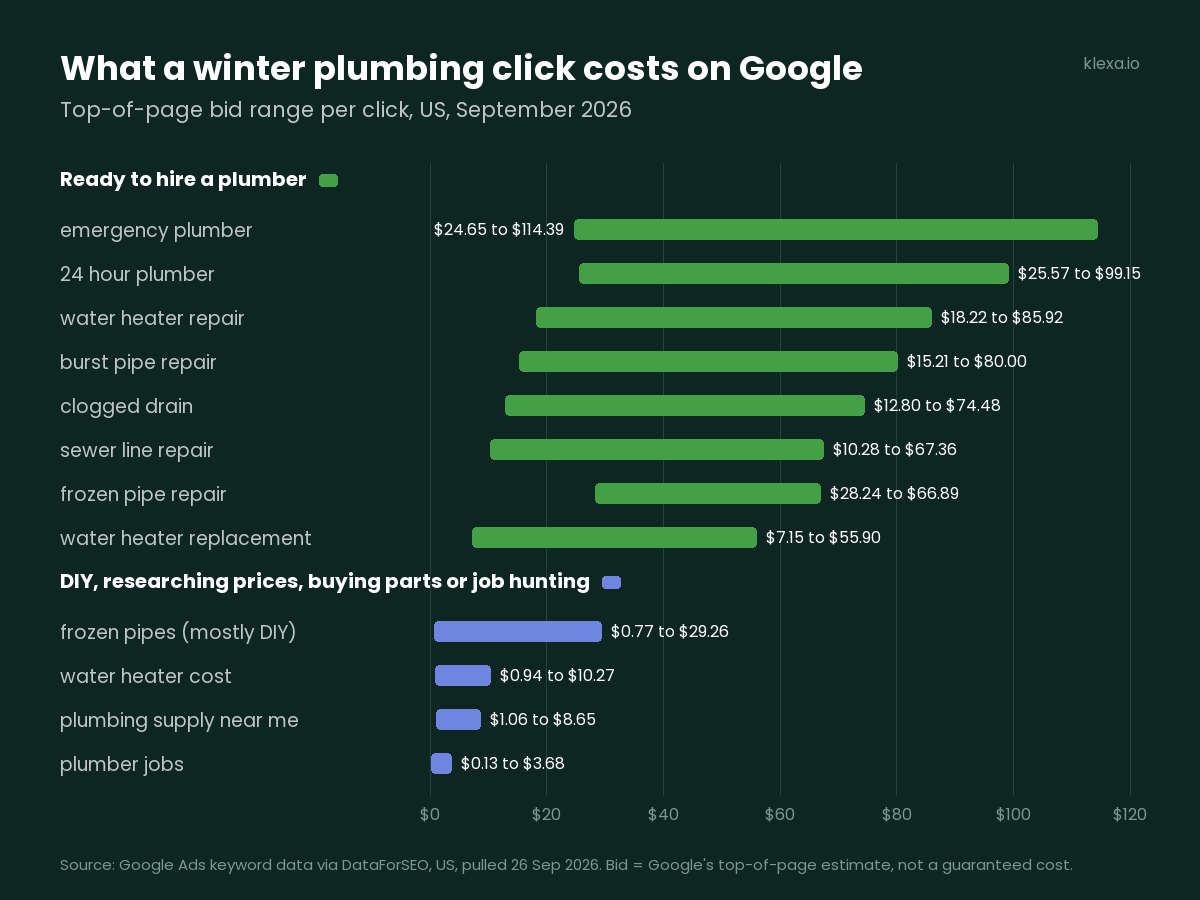
Emergency searches sit at the top of this table, and a single “emergency plumber” click can pass $100 at the top of the page. That’s the price of a customer who calls today.
Now look at the bottom four rows. They’re cheap for a reason. “Frozen pipes” on its own is mostly people trying to thaw a line with a hair dryer. “Water heater cost” is someone reading. “Plumbing supply near me” is a DIYer or another contractor looking for parts. “Plumber jobs” is a tech looking for work. Plumbing ads that match those searches get clicks that look like a bargain and book almost nothing.
A quick worked example, with the assumptions stated. Say your average emergency click lands around $55, inside the ranges above. A $3,000 month buys roughly 54 clicks. If one in eight becomes a real call (an assumption for the example, not a benchmark), that’s about seven calls. Now let a third of those clicks go to DIYers and job seekers. You’re down to four or five calls for the same money. That’s why the number to watch is cost per booked job, not cost per click.
Two questions to ask about your own plumber ads
Answer these before you change anything in your plumbing advertising.
Do you know which search produced last week’s water heater job? Not which campaign. Which search, and which call. If the answer is “the phone’s ringing, so the ads work”, you’re guessing. Plenty of plumber ads look healthy on clicks and even on call count, while the booked work comes from somewhere else. Call tracking that ties each call to the keyword and the ad is what separates the two. If that isn’t set up, start with our plain guide to Google Ads conversion tracking.
Are emergency calls and planned work in the same campaign? A burst pipe at 11pm and a homeowner comparing tankless water heaters are different people with different job values. One shared budget means whichever one Google finds cheaper gets the money. Usually the wrong one.
If either answer made you wince, that’s where your winter budget is leaking.
Plumbing advertising ideas for the cold months
Most plumbing marketing ideas you’ll find are written for any month of the year. Here’s what changes when it gets cold.
Water heater replacement ads, live in October
Replacement searches peak in October and stay high through December. This is planned work, so the ad can carry a real price, a financing line and a same-week install promise. Send it to a page about water heater replacement, not your homepage. A tankless option belongs on that page too; “tankless water heater installation” searches hit 60,500 in January and February 2026.
Call-only ads for burst pipes at night
Someone standing in an inch of water wants a phone number, not a website. Call-only ads that run into the night, answered by a real person (a CSR, an answering service, or you), catch the calls your competitors send to voicemail. If nobody picks up after 6pm, don’t run them after 6pm.
Frozen-pipe ads that follow the forecast
Frozen-pipe demand shows up in bursts. Build the campaign in November, keep it small, and give it room to grow when a hard freeze is forecast for your service area. The ads, landing page and call handling should be ready before the first cold snap, not written during it.
Plumbing Facebook ads for past customers
Plumbing Facebook ads are weak at emergencies. Nobody scrolls Instagram hoping to find a plumber for a burst pipe. They’re decent at reminding past customers to winterize outdoor lines, book a water heater flush, or keep your number on the fridge. Upload your own customer list to Meta rather than targeting cold audiences. Small local boosts can surprise you, too: one PlumbingZone member spent $20 boosting a post and got a paying call on the second day. Just don’t plan your winter around that kind of luck.
A plumbing billboard or mailer is for the name, not the call
A plumbing billboard near a busy road, a wrapped van, or a postcard to the neighborhoods you already serve builds recognition. That has value. Just don’t judge it on calls, and don’t fund it with money that should be answering search demand. A PlumbingZone member weighing a radio deal called that kind of ad “fishing”: you’re hoping someone needs a plumber at the moment they hear you, when what books work is being there when they go looking. The best plumbing ads, in any format, look the same: one problem, one offer, one phone number, one reason to act this week.
Where plumbing advertising budgets leak in winter
The leaks are boring. That’s why they last. One PlumbingZone owner summed up their first try at Google ads as mostly junk calls and a budget that ran out “faster than the phone ever rang”. Here’s usually why.
- DIY searches. “How to unfreeze pipes” went from 140 searches in October 2025 to 60,500 in January 2026. Those people want a hair dryer, not a plumber.
- Job seekers. “Plumber jobs” and “plumber salary” draw 14,800 searches a month each.
- Parts shoppers. Supply houses, water heater parts, fittings.
- Clicks from outside your service area. If calls come in from towns you’d never drive to, the location settings need a look.
- Missed calls. An ad that rings a phone nobody answers after hours is worse than no ad. You still paid for the click.
- One campaign for everything. Drain cleaning, water heaters, sewer work and emergencies sharing a budget. The cheapest clicks win, and they’re rarely the valuable ones.
Filtering out the wrong searches is mostly done with negative keywords. The idea is simple. The upkeep isn’t. There’s more in our guide to negative keywords.
Running it yourself vs hiring a plumbing advertising agency
You can run plumbing ads yourself. Plenty of plumbing business owners do for a while. What usually breaks is the upkeep: search terms reviewed every week, budgets moved when the forecast changes, calls tied back to keywords.
If you hire a plumbing advertising agency, ask for three things before signing. You own the Google Ads account. Reporting shows booked jobs, not just clicks. And the contract lets you leave. Good advertising for plumbers is judged by jobs on the board, not by impressions.
KLEXA works the way that list describes. Senior strategists run the account, it’s month to month, and you keep the account and data if you leave. KLEXA sets up call tracking before spending, and splits emergency work from planned work. One example: Buffalo Plumbing came to KLEXA with a brand-new account and no tracking; with conversion tracking set up first, the account produced 89 tracked leads at $92 each in its first 90 days, and its top campaign reached $63 a lead. That’s one account, not a promise.
See our plumbing marketing offer: Google Ads with no setup cost and no management fee until your first booked call.
Questions plumbing owners ask about advertising
How much should a plumbing company spend on advertising in winter?
Start from job values, not a round number. Work out what a booked emergency call and a water heater replacement are worth to you, how many you want, and what you can afford to pay per lead. Then check that against click costs like the ones above. Our Google Ads budget calculator does the math.
Are plumbing Facebook ads worth it?
For past customers and seasonal reminders, often yes. For emergency calls, rarely. People with a burst pipe search Google. Use Facebook to remind, and search to capture.
When should plumbing advertising switch to winter?
Water heater replacement ads by October, when those searches peak. Frozen-pipe and burst-pipe campaigns built by early December, because Google Ads keyword data shows frozen pipe searches jumping from 9,900 in December 2025 to 40,500 in January 2026.
What are the best plumbing ads for a small plumbing company?
Search ads on a short list of hire-intent searches in your service area, with a phone number that gets answered. Small budgets get wasted fastest on broad terms, so fewer searches done well beats a wide net. If you run Local Services Ads, export your old reports before your account moves into Google Ads.
What’s the fastest way to advertise a plumbing business?
Google Search ads, because they reach people who are already looking. First calls often come within a week or two. Just set up call tracking first, so you know which searches turn into jobs.
Want a second pair of eyes before the first freeze?
KLEXA runs a Free Google Ads Audit for plumbing companies. We’ll look at your search terms, call tracking and budget and show you where money is leaking going into winter, whether or not you hire us.