If your Search campaigns use Google’s campaign-level broad match setting, or standalone automatically created assets, Google is upgrading them to AI Max this month without asking you. The upgrades started in September and, in Google’s own words, all upgrades for eligible campaigns are expected to conclude by the end of the month.
That is one sentence from Google’s Ads and Commerce blog, and it deserves more attention than most implant practices are giving it.
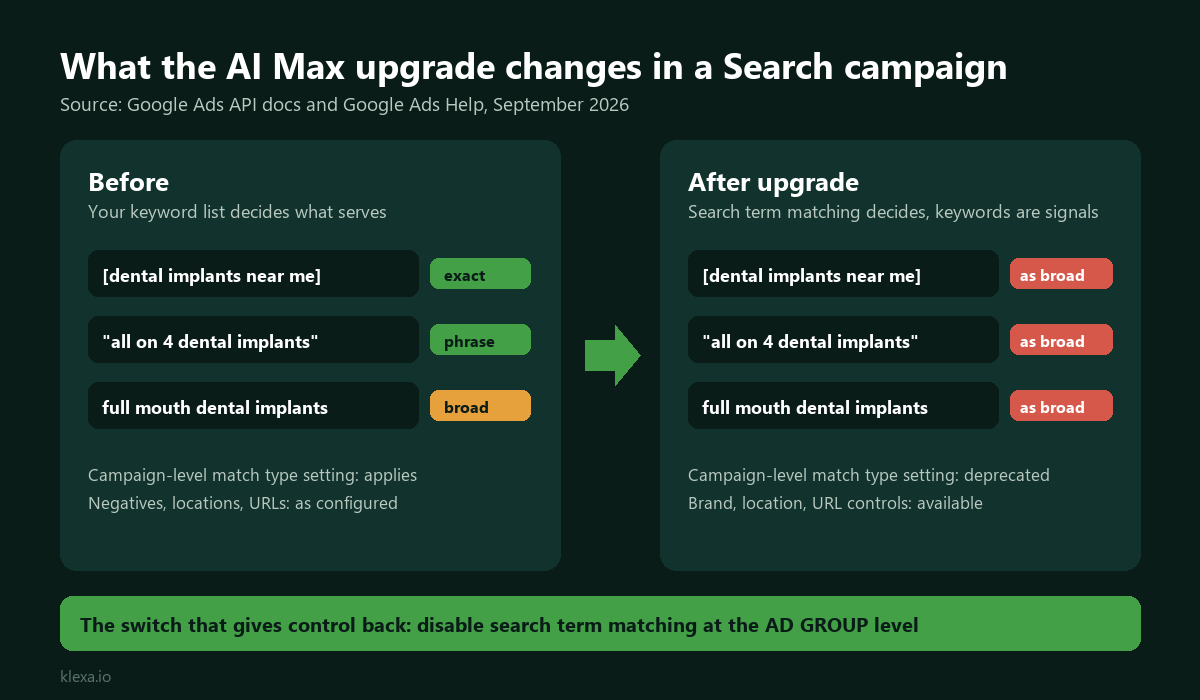
The change is not cosmetic. Google’s developer documentation for AI Max puts the mechanism plainly: under AI Max for Search campaigns, all keywords are treated as broad match by default unless search term matching is disabled at the ad group level. The campaign-level keyword match type setting is deprecated and does not apply.
Read that twice if you run Google Ads for dentists, or pay a dental marketing agency to run it for you. Your exact and phrase match keywords do not disappear. They stop meaning what they meant.
KLEXA has spent the last few weeks inside Google Ads for dentists accounts looking at exactly this, and implant keywords are the worst possible place to lose that control, for a reason the numbers make obvious.
What is actually changing in Google Ads for dentists, scoped precisely
The auto-upgrade is narrower than some of the coverage suggests, and the details decide whether this applies to you.
- Affected now: Search campaigns using the campaign-level broad match setting, and campaigns using standalone automatically created assets. Google’s help page on the broad match campaign setting states that starting in September 2026, campaigns using it will automatically be upgraded to AI Max.
- Not yet: Dynamic Search Ads. Google originally bundled DSA into the same September window, then pushed the DSA sunset and auto-upgrade to February 2027.
- What the upgrade turns on: Google’s blog says all three AI Max features, search term matching, text customisation and final URL expansion, will be enabled, with legacy URL controls preserved.
- What search term matching does: per Google’s help page, it uses broad match and keywordless technology, learning from your current keywords, creatives and URLs to find searches your keyword list would not have matched.
So the practical question is not “am I on Google Ads” but “does any campaign in my account have the broad match campaign setting switched on, or use automatically created assets.” If the answer is yes, that campaign is being upgraded in place this month.
Why implant keywords are the worst place to lose match-type control
Dental implant marketing has a shape most trades do not, and dental implant advertising on search is where it shows. The high-value searches sit right next to a much larger population of searches that will never book a consult, and the two look almost identical to a matching system that learns from your keywords and your landing pages.
Google Keyword Planner, United States, pulled 13 September 2026:
| Search term | Monthly searches | Top-of-page bid range | What it usually is |
|---|---|---|---|
| dental implants near me | 110,000 | $11.02 to $48.70 | a patient choosing a practice |
| dental implants | 165,000 | $6.59 to $29.74 | mixed research and intent |
| all on 4 dental implants | 22,200 | $6.76 to $26.00 | a full-arch prospect |
| full mouth dental implants | 12,100 | $6.98 to $28.05 | a full-arch prospect |
| dental implant cost | 135,000 | $3.00 to $16.25 | price research, often months out |
| affordable dental implants | 6,600 | $7.15 to $30.00 | price-led shopping |
| cheap dental implants | 5,400 | $4.29 to $23.32 | price-led shopping, high competition |
| free dental implants | 2,400 | $2.08 to $8.42 | will not book a paid consult |
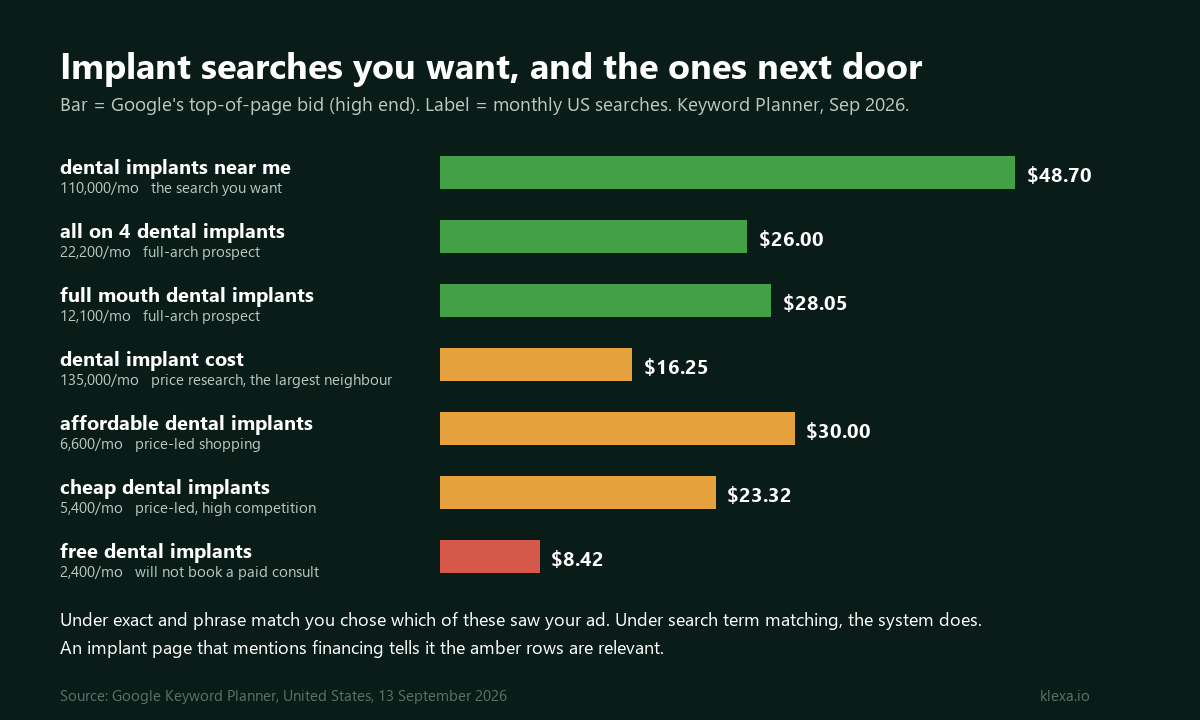
Look at the two biggest rows. “Dental implants near me” is the search a practice wants, and it costs up to $48.70 a click at the top of the page. “Dental implant cost” is larger, at 135,000 searches a month, and it is the search a matching system reaches for first when told to find more queries related to your implant keywords, because it is the most common thing people type about implants.
Under exact and phrase match, you decided whether “cost”, “cheap” and “free” searches saw your ad. Under search term matching, the system decides, learning from your keywords, your ad copy and your landing pages. If your implant page mentions financing, pricing or affordability anywhere, which nearly every implant page does, you have just told it that price searches are relevant.
The arithmetic of dental PPC, with stated assumptions
Every input here is an assumption you should replace with your own numbers. It is here to show the shape of the risk, not to report a result.
Take a practice spending $3,000 a month on implant search. At a $30 click, that is 100 clicks. If exact and phrase match kept 80 of those on near-me and full-arch intent, and search term matching shifts 30 of them into cost, cheap and free searches, the practice has moved $900 a month from prospects who book consults to people comparing prices for a procedure they may have next year, or never. At a 10% click-to-call rate and a 50% consult booking rate, that is roughly one and a half booked consults a month gone, on a procedure where a single case is often a four or five figure ticket.
The reason this bites implants harder than hygiene or whitening is the ticket size, which is also why dental lead generation for implants is priced so differently from general dentistry. When one consult is worth that much, thirty misdirected clicks a month is not a rounding error. It is the difference between a campaign that pays for itself and one that does not.
The controls Google says you keep, and the one it does not mention
Losing match types is not the same as losing control. Google’s help page for AI Max lists the levers that remain, and one of them is the whole answer for implant practices.
- Search term matching can be disabled per ad group. The developer documentation names the setting directly: search term matching can be turned off at the ad group level, and when it is, that ad group’s keywords are not treated as broad by default. This is the switch that matters.
- Brand inclusions and exclusions at campaign and ad group level, to keep your ads on or off searches that name specific brands.
- Locations of interest at ad group level, which Google describes as reaching customers based on geographic intent even in keywordless matches. For a practice that only serves one metro, this is not optional.
- URL inclusions and exclusions, so final URL expansion cannot send implant traffic to your hygiene page.
- Feature toggles. Google states that individual features can be turned off within campaign or ad group settings rather than accepted as a bundle.
What the pages I read do not address is negative keywords. Google’s upgrade announcement names brand and URL controls as preserved; it does not say how existing negative lists interact with keywordless matching. I am not going to tell you they carry over cleanly, because the documentation does not say so. Treat the negative list as something to audit in the first week after the upgrade, not something to assume. Our guide to negative keywords in Google Ads covers why that list is ongoing work either way.
What practices running Google Ads for dental implants are already saying
The forums were arguing about this before the upgrade had a date.
In an r/googleads thread on leads for All-on-4 dental implants, one reply told the practice to run broader with looser targeting and let phone qualification handle filtering, on the theory that cost per lead drops when volume rises. That is exactly the logic AI Max encodes, and for dental implant leads it is the expensive version of the argument: the volume you gain is cost and free searches, and phone qualification means your front desk pays for the filtering the match type used to do.
In r/adwords, a dental clinic reported 60 clicks and no leads, and the reply was that $196 of spend is not enough data to decide anything. True, and it cuts both ways. After the upgrade, a practice will need more spend before it can tell whether search term matching is helping or quietly relocating the budget, which is a strong argument for watching the search terms report weekly rather than monthly through October.
A dental marketing agency’s own post on LinkedIn described running phrase and exact match on terms like “dental implants” plus a city and “implant dentist near me”, with negatives, instead of going broad. That is the setup this upgrade dismantles in any campaign carrying the broad match campaign setting, which is why the first job is finding out whether you have it on.
What to do in your Google Ads for dentists account before 30 September
This is the what and the why of PPC for dentists this month. The exact configuration is account-specific and it is the work.
- Find out whether you are affected at all. Check each Search campaign for the broad match campaign setting and for automatically created assets. If neither is on, your campaigns are not in this month’s upgrade, though AI Max remains available to switch on.
- Decide ad group by ad group, not account by account. Search term matching is disabled per ad group. A full-arch ad group with $48 clicks deserves a different decision from a general dentistry ad group.
- Set locations of interest on implant ad groups. Keywordless matching without a geographic anchor is how a Phoenix practice pays for a Tampa search.
- Lock final URLs for implant traffic. URL exclusions exist so that expansion cannot land a full-arch prospect on a page about cleanings.
- Read the search terms report weekly through October. If “cost”, “cheap”, “free”, “grants” and “insurance” start appearing against implant ad groups, the drift has begun and the negatives need work that week.
- Count booked consults, not form fills. None of the above can be judged if the account counts a phone tap as a conversion. Connected calls of real length, and ideally the consult itself, are the conversion that should be teaching the bidding. Our write-up on call tracking for service businesses covers how that gets wired in, and why Google Ads is not working shows how to tell a tracking problem from a matching problem when both look the same from the dashboard.
Google’s own figure for AI Max is an average of 7% more conversions or conversion value at similar CPA or ROAS when the full feature set is used, compared with search term matching alone. That is Google’s number, across all advertisers, and it is an average. An implant practice with a five figure case value and a 135,000-a-month price-research population next door is not the average advertiser, and a 7% lift in conversions is not worth much if the conversions being counted are calls asking whether you take payment plans.
How KLEXA runs Google Ads for dentists through this upgrade
KLEXA builds dental implant campaigns around one conversion, the booked consult, and prices the work so the risk of the first month sits with us rather than the practice.
- $500 one time to set it up. That covers conversion tracking and the campaign build, including the ad-group-level decisions above.
- No management fee until it books you a consult. Not a lead. A booked consult.
- Then $1,500 a month, with local SEO included at no extra cost.
A dentist marketing agency that understands implant economics should be reading your search terms report with you before the end of the month. If you would rather have someone do that before the end of the month, book a call, and bring the report. It usually shows the drift before the invoice does. For the broader version of what goes wrong when an agency runs a dental or contractor account on defaults, our piece on what owners complain about with marketing agencies applies well beyond HVAC, and our Google Ads budget guide covers what a defensible implant budget looks like once the waste is out.
Questions dental practices are asking this month
Is every Google Ads for dentists Search campaign being upgraded to AI Max in September 2026?
No. Google’s announcement scopes the September auto-upgrade to campaigns using the campaign-level broad match setting and campaigns using standalone automatically created assets. Dynamic Search Ads were originally included and have been moved to February 2027. A Search campaign using keyword-level exact and phrase match without the broad match campaign setting is not in this month’s upgrade, though AI Max can be switched on manually.
Do my exact match keywords stop working under AI Max?
They do not disappear, but Google’s developer documentation states that under AI Max all keywords are treated as broad match by default unless search term matching is disabled at the ad group level, and that the campaign-level keyword match type setting is deprecated. In practice your exact match keyword becomes a signal the system learns from rather than a boundary it respects, unless you turn search term matching off for that ad group.
Why does this matter more for dental implants than for general dentistry?
Ticket size and neighbours. A single implant case is often a four or five figure ticket, and the high-intent searches, such as “dental implants near me” at up to $48.70 a click, sit next to a much larger population of price searches: “dental implant cost” alone draws 135,000 searches a month in the US. A keywordless matcher learning from an implant page that mentions financing will treat those price searches as relevant, and each one costs implant-level click prices.
Can I turn off search term matching for just my implant ad groups?
Yes. Google’s documentation names an ad-group-level setting that disables search term matching, and states that keywords in that ad group are then not treated as broad by default. This lets a practice keep the upgrade’s features on a general dentistry ad group while holding implant and full-arch ad groups to the keyword list.
Do negative keywords still work after the AI Max upgrade?
Google’s upgrade announcement and help pages name brand controls, location controls and URL controls as the levers that remain, and say legacy URL controls are preserved. The pages do not address how existing negative keyword lists interact with keywordless matching. The honest answer is to audit the search terms report and the negative list in the first week after your campaign is upgraded rather than assume they carry over unchanged.
Should a dental practice running Google Ads for dentists just opt out of AI Max entirely?
For campaigns caught by the September upgrade, there is no opt-out of the upgrade itself, but Google states that individual features can be turned off within campaign or ad group settings. The practical middle path is to disable search term matching on high-ticket implant ad groups, set locations of interest and URL exclusions everywhere, and judge the rest on booked consults over several weeks rather than switching everything off on principle.
Sources named in this article, in plain text: Google Ads and Commerce blog, “Google’s Dynamic Search Ads are upgrading to AI Max” and “Steer performance with new AI Max features”; Google Ads Help, “How AI Max for Search campaigns works” and “About the broad match keywords campaign setting”; Google Ads API documentation, “Get started with AI Max for Search campaigns”; Search Engine Roundtable’s report of the 1 September start date. Search volumes and bid ranges are from Google Keyword Planner, United States, pulled 13 September 2026. Practitioner comments are paraphrased from public threads in r/googleads and r/adwords and a public LinkedIn post by a dental marketing agency. No client accounts are named or described.