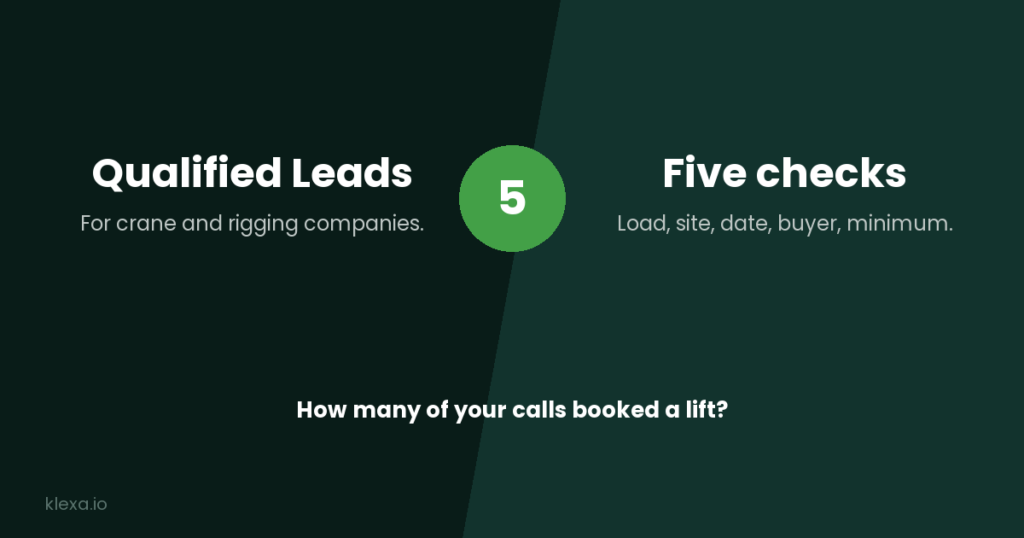
- A qualified lead for a crane and rigging company is a call or quote request about a lift you want, at a site you serve, on a real date, from someone who can book it.
- In US Google searches, crane operator jobs (8,100 a month) runs at two-thirds the volume of crane service (12,100), so loose crane keywords buy job-seeker calls.
- Google Ads Help recommends a qualified lead or converted lead as the conversion goal for offline conversion imports, not every call.
- Since 15 June 2026, offline conversion and enhanced conversions for leads uploads go through Google’s Data Manager API; click-ID matches must be uploaded within 90 days.
Your Google Ads report says you got 40 leads last month. Your dispatcher says maybe six of them were real. Both can be telling the truth.
Here’s the short answer. Qualified leads for a crane and rigging company are calls or quote requests about a lift you actually want, at a site you serve, from someone who can book it. Most ad accounts don’t measure that. They count every call that lasts long enough, so Google happily finds you more of the cheapest calls it can get: job seekers, hot tub owners and people checking prices.
The fix isn’t more budget. It’s three things, in order. Decide what a qualified lead is. Score the leads you already have. Then tell Google which ones turned into booked lifts, so it bids for those instead of for the phone ringing.
What is a qualified lead for a crane and rigging company?
Ask a software company “what is a qualified lead” and you’ll hear about ebook downloads and newsletter sign-ups. You’ll hear “sales qualified lead” too: a lead the sales team has vetted and wants to call back.
None of that fits a crane yard. Your buyers pick up the phone. So a qualified lead is a call or form that passes five checks:
- What’s being lifted. A load, a weight and a rough reach your mobile cranes, boom trucks or rigging crew can handle.
- Where. A jobsite inside the radius you actually send cranes to.
- When. A date or a window, not “someday, maybe”.
- Who’s calling. A general contractor’s estimator on a construction project, a project manager, an HVAC contractor, a plant or facility manager. Someone who can book the pick.
- Does it pay. It clears your minimum. A two-hour residential pick can be a fine job, or it can tie up a boom truck you needed elsewhere.
Calls that pass all five are qualified leads. That’s lead qualification in plain terms. It’s also exactly what your dispatcher does in their head on every call.
So here’s my first question for you. If I pulled your last 20 ad calls, how many would pass all five?
Why crane ads ring with the wrong calls
Crane searches look busy, and they are. But they’re mixed. Here’s what people in the US typed into Google each month, on average over the year to August 2026, from Google Ads keyword data.
| Search | Searches a month | Who’s usually typing it |
|---|---|---|
| crane service | 12,100 | A buyer, or someone researching |
| crane rental | 9,900 | A buyer, or a DIY renter |
| crane operator jobs | 8,100 | A job seeker |
| crane rental near me | 3,600 | Usually a buyer |
| tree removal crane | 880 | A homeowner or a tree service |
| crane jobs | 880 | A job seeker |
| crane rental cost | 590 | Someone checking prices |
| how much does it cost to rent a crane | 260 | Someone checking prices |
| crane for hot tub | 140 | A homeowner |
Swipe the table sideways to see every column.
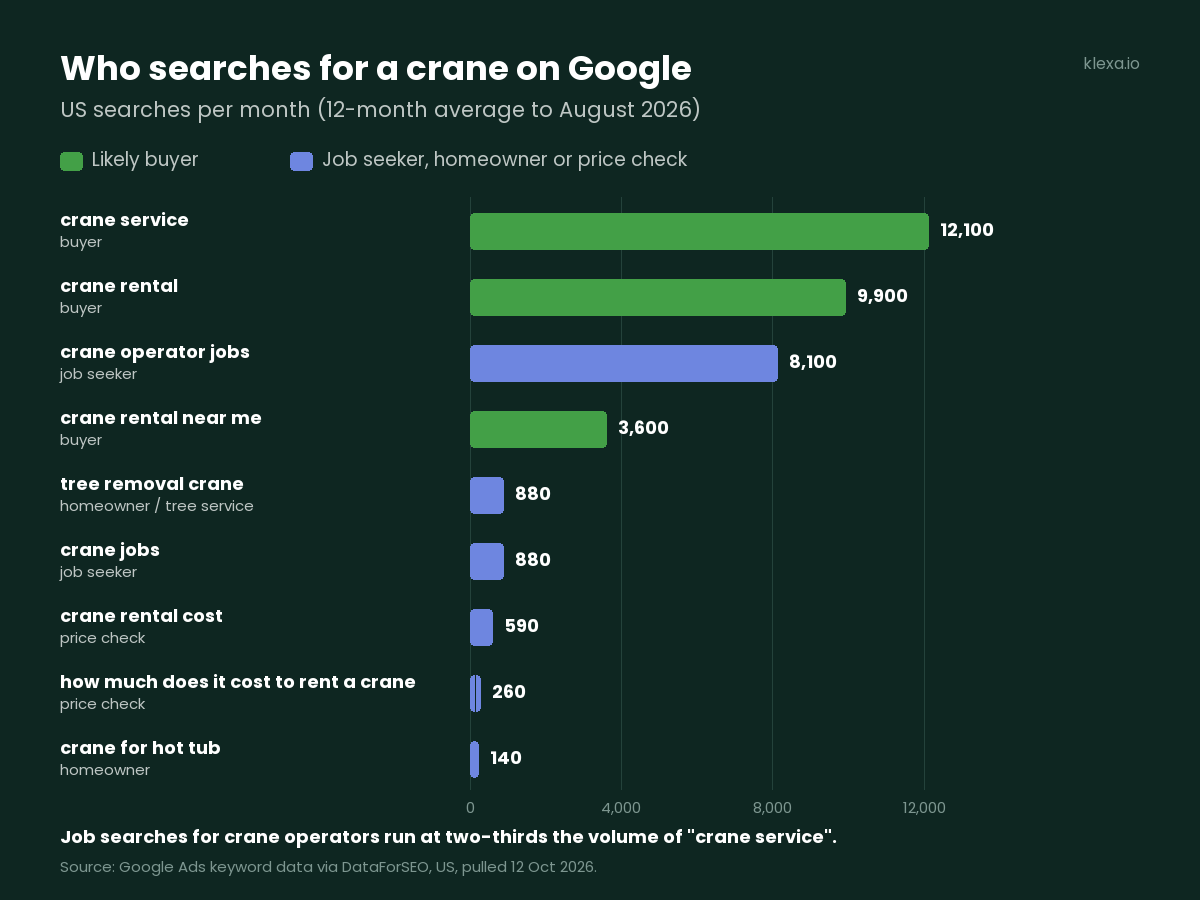
Look at the third row. People searching for crane operator jobs type it two-thirds as often as “crane service” itself. If your ads run on loose “crane” phrases, a slice of your budget is quietly paying for job hunters.
This isn’t a theory. A crane hire company posted in the Google Ads Community forum under the title “advertised for crane services but people are calling for job”. It was running a Smart campaign, and a Google Product Expert’s advice was to move to a standard Search campaign so it could control keywords and exclusions. That thread now ranks near the top of Google for “google ads for crane companies”.
Then there’s tree removal. “Tree removal crane” had an average cost per click of about $18.29, nearly double the $9.68 for “crane service” itself. Tree services bid on it too, and the job is often residential. You can win that click and still lose money on the lift.
Price research adds up as well. Add “crane rental price” (260) to the two cost searches above and you get roughly 1,100 a month. Some of those people will book. Many are pricing a project that’s months away.
None of these are bad leads in the moral sense. They’re just not the qualified leads you’re paying for. Lead quality starts with knowing which kind of caller is on the line.
Counting every call teaches Google to find cheap calls
Here’s the part most owners never get told.
Most crane accounts count a phone call as a conversion once it passes a minimum length. Google Ads call tracking lets you set that minimum yourself. Set a short one, and a job seeker asking “are you hiring?” counts exactly the same as a project manager booking a 90-ton pick.
Now add Smart Bidding. Strategies like Maximize Conversions and Target CPA learn from whatever you call a conversion. If every call counts, the algorithm’s job is simple: get more calls, cheaper. Whether they’re qualified leads never enters into it.
And which calls are cheapest? Usually the ones nobody else bids hard on. “Crane operator jobs” averaged about $1 a click in the same data. So the system drifts toward unqualified leads while your cost per lead looks great on the report.
That’s the trap in Google Ads lead quality. The dashboard rewards volume. Your crane yard needs qualified leads that turn into work.
Score last month’s leads before you change anything
Don’t touch a bid yet. First, find out what you’ve actually been buying.
Pull every ad call and form from last month. Then sort each one into one of five buckets:
- Job seeker or vendor. Wanted work, or wanted to sell you something.
- Out of area or out of scope. Wrong city, wrong size, or something you don’t do.
- Price check. Wanted a number, no date, no site.
- Quoted. A real lift, a real site, and you sent a price.
- Booked. The crane went out.
Buckets four and five are your qualified leads. Everything else is noise you paid for.
This takes an hour with your call log and a spreadsheet. It’s the simplest lead tracking you’ll ever do, and it’s the step most accounts skip.
Now work out two numbers. Your cost per lead is ad spend divided by all five buckets. Your cost per booked job is ad spend divided by bucket five alone. The gap between them is what the junk costs you.
So, the second question. Do you know your cost per booked job from Google Ads right now? If the honest answer is no, start there. Everything else depends on it.
How to get more qualified leads: send booked lifts back to Google
Once you know which calls became jobs, you can tell Google. This is offline conversion tracking, and it’s how you get more qualified leads without guessing.
Google’s own advice is plain. Its help page on offline conversion imports says the best practice is to choose a “qualified lead” or a “converted lead” as your conversion goal. In crane terms, that’s “quoted” and “booked”. You can send both. What you shouldn’t send as your main goal is “the phone rang”.
Here’s how it works, in outline:
- Every ad click carries a click ID, called a GCLID. Your form or call tracking keeps it with the lead.
- When a lead becomes a quote or a booked lift, that outcome goes back to Google Ads with the click ID.
- Google now knows which keywords and searches led to real work, and it bids toward more of them.
Enhanced conversions for leads makes the match stronger. Google describes it as an upgrade to offline conversion imports, not a separate thing: it adds hashed contact details, like an email address, so a booked job can be tied back to the ad even when the click ID is missing.
Three dates and windows matter here, all from Google Ads Help:
- 15 June 2026. Google ads offline conversions and enhanced conversions for leads uploads moved to Google’s Data Manager API. If someone set up your uploads before that, check they still run.
- 90 days. A booked job matched by click ID has to be uploaded within 90 days of the click. Matches made on contact details have 63 days.
- At least daily. Google recommends uploading on a regular schedule, ideally every day, when Smart Bidding is going to use the data.
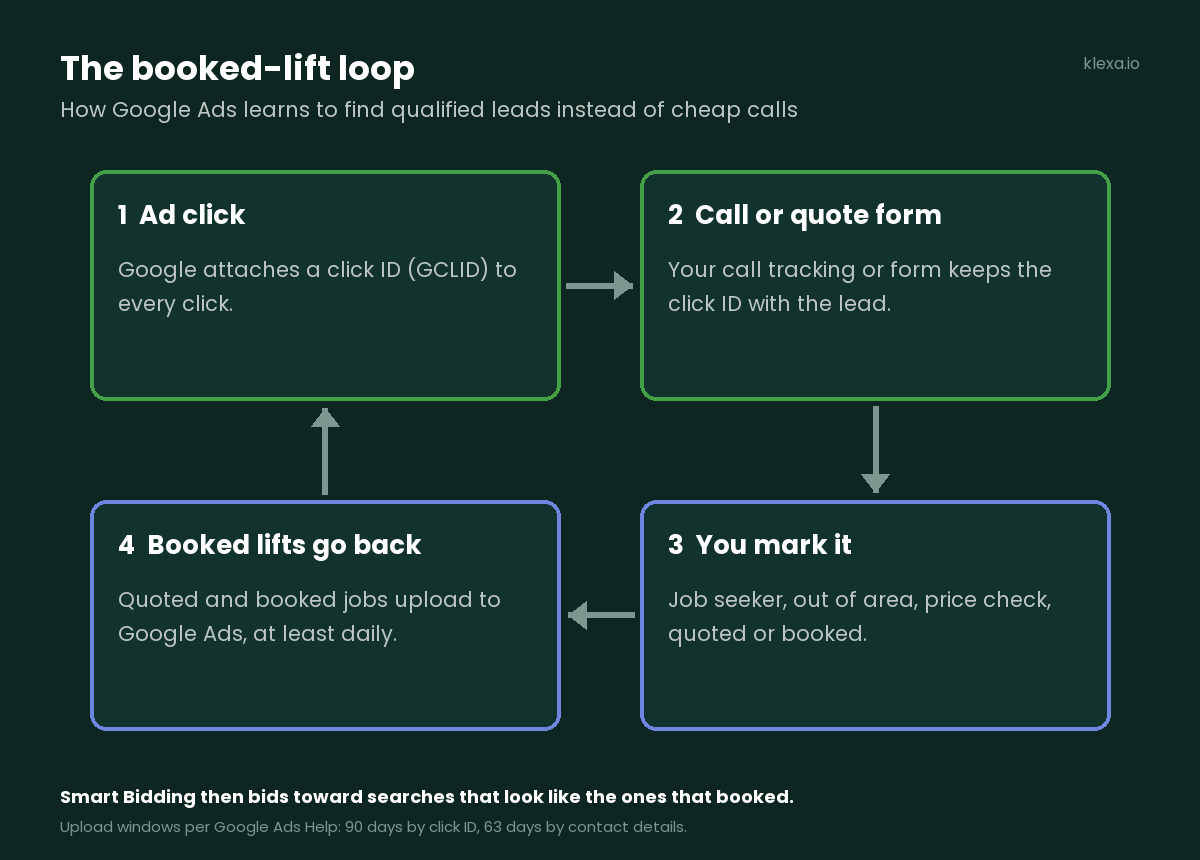
This is the Google Ads offline conversion tracking that turns your dispatcher’s knowledge into bidding data. It doesn’t need a fancy CRM. It needs someone to mark the outcome every week, without fail. If you want the setup side in more depth, our Google Ads conversion tracking guide covers it.
One honest caveat. A small account with a handful of booked jobs a month gives Google very little to learn from. The loop still pays off, because you finally see which searches make money, but the bidding improvement builds slowly.
Not every booked lift is worth the same
Even qualified leads aren’t equal. A booked hot tub lift and a booked plant relocation are both “booked”, but they’re not worth the same to you.
Google lets you put a value on each conversion. So a booked rigging or machinery-moving job can count for more than a booked residential pick. Once Google has enough of those values, bid strategies can aim at value, not just volume. Google’s help page suggests about six weeks of steady values before switching to a return-on-ad-spend target. We go deeper on that in value bidding for contractors with long sales cycles.
This is also where residential work becomes a decision instead of an accident. Some crane companies like hot tub and truss lifts. They’re quick, they fill gaps, and they pay a minimum. Others lose a full commercial day to them. Neither is wrong. Decide, then price it with a clear minimum or keep it out of the ads entirely.
And give rigging and machinery moving their own campaign and budget. Searches like “machinery moving” (720 a month) and “heavy equipment moving” (1,000) were rated high competition in the same data. They’re different buyers from crane rental, and they shouldn’t fight it for budget.
Stop the junk before the phone rings
Measurement tells Google what you want. Intent control stops paying for what you don’t.
The what and why are simple, even if the exact build takes judgment:
- Match the words to the buyer. Phrase and exact match on lift and service searches, rather than letting broad match roam into jobs and training.
- Exclude the obvious. Jobs, salary, training, school, free and toy searches. Our guide to negative keywords in Google Ads explains how that list works.
- Target people in your area. Google’s location setting can include people who are merely “interested in” a place. For a crane yard, you want people in it.
- Say what you do in the ad. Put the service and the tonnage in the headline. A rushed job seeker who taps “Call” on a vague ad costs the same as a buyer.
- Make the landing page and quote form do some qualifying. Ask for the load weight, the site address and the date. People who can’t answer usually aren’t ready to book.
- Answer the phone like it matters. A qualified caller who hits voicemail at 7 a.m. calls the next crane company.
Here’s the catch with exclusions, and forum threads show it again and again. Negatives block the word “jobs”. They don’t block a job seeker who searches “crane company” and calls the number. In one Google Ads Community thread, 34 advertisers clicked “I have the same question” about exactly this. That’s why measurement matters more than any exclusion list. Only booked-job data teaches Google who actually hires you.
If your account was built as one big “crane” campaign, the problems with generic Google Ads for crane and rigging companies will look familiar. And if your best work comes through general contractors’ bid lists rather than search, read where construction leads really come from for crane and rigging companies.
What KLEXA does in a crane account
KLEXA runs Google Ads for a crane and rigging company and builds the account around one number: booked lifts, not calls.
In practice that means tracking gets fixed before bidding changes. Crane rental, rigging and machinery moving are kept apart. Search terms get read every week. A line on our homepage shows the kind of call that work makes: “free crane rental”, excluded; “crane rental brooklyn”, kept.
KLEXA also feeds booked jobs back into the account, so Google learns what a good crane customer looks like. You can see how that works on our Google Ads for crane and rigging companies page, and how we approach the trades more widely on Google Ads for contractors.
Questions crane owners ask about qualified leads
What is a qualified lead for a crane company?
A call or quote request about a lift you can do and want, at a site you serve, on a real date, from someone who can book it. Job seekers, out-of-area calls and pure price checks are leads, but they aren’t qualified leads.
Should a crane company count every call as a lead in Google Ads?
No. Count calls if you must, with a sensible minimum length, but send back which calls were quoted or booked. Otherwise Smart Bidding chases cheap calls, and job seekers are some of the cheapest.
What is offline conversion tracking in Google Ads?
It’s how you tell Google which ad leads turned into real results after the click, such as a quote or a booked lift. Google recommends a qualified lead or converted lead as the goal. Since 15 June 2026 those uploads go through Google’s Data Manager API.
Are residential crane jobs bad leads?
Not always. Hot tubs, trusses and tree work can fill gaps and pay a minimum. The problem is paying commercial click prices for them by accident. Decide whether you want them, then price them or exclude them on purpose.
How long before Google bids on booked jobs instead of calls?
It depends on volume. Google needs a steady flow of uploaded outcomes, ideally daily, before bidding can lean toward qualified leads. For value-based targets its help page suggests about six weeks of consistent values first.
Not sure how many of your leads are real?
KLEXA runs a Free Google Ads Audit for crane and rigging companies. We’ll look at your search terms, how your calls are counted and what happens after the phone rings, then tell you plainly where the budget goes and how to get more qualified leads from it.