
- Searches for “buy roofing leads” ran 50 to 140 a month through 2026 and hit 720 in September 2025, when storm season landed (Google Ads keyword data, US, October 2026).
- Service Direct publishes $85 to $550 per exclusive roofing lead. Contractor reports put Angi at $15 to $85 a lead plus a $300 to $500 annual membership on a 12-month term.
- Every lead vendor is buying the same homeowner you could buy directly: Google’s top-of-page bids run $9.79 to $85.00 a click across eight roofing searches.
- Judge every source on cost per booked roof: what you paid it in 90 days divided by the roofs you signed, never on cost per lead.
Here’s a pattern in the search data. Through most of 2026, between 50 and 140 roofers a month typed “buy roofing leads” into Google. In September 2025, when storm season landed, that number jumped to 720 (Google Ads keyword data, US, pulled October 2026).
That’s the month the pitches arrive. It’s also the month the math gets skipped.
So this is the math. What roofing lead generation companies actually sell, what each kind charges, the one number that decides whether any of them is worth it, nine questions to ask before you sign, and when buying leads is the right call.
KLEXA runs Google Ads for roofers and has no leads to sell you. That’s the only reason you’re getting the version without a sales pitch at the end of every section.
What roofing lead generation companies actually sell (the four kinds)
Most lists of roofing lead generation companies mix four different businesses together. “Roofing lead companies” covers all four, and they don’t compete with each other as much as you’d think. Figure out which kind is calling you before you talk price.
The first kind is the shared marketplace. Angi is the big one, and HomeAdvisor isn’t a separate choice anymore. It was folded into Angi and runs as Angi Leads, so signing up for both doubles your spend inside one company.
One flooring contractor on the ContractorTalk forum paid both for eight years and watched leads arrive marked “via Angie’s List” on his HomeAdvisor bill. Two brands, one invoice. Thumbtack and Networx work the same way: a homeowner fills in a form, the marketplace sells that form to several roofers at once, and everyone pays.
The second kind sells exclusive, pay per lead roofing calls and forms. Service Direct, RoofClaim and Modernize sit here, and so do live-call sellers like 33 Mile Radius, which is now part of EverConnect.
Here’s what most roofers don’t realize. These companies are usually running Google Ads, Local Services Ads or Facebook ads under their own brand name, on their own landing page, with their own tracking number. You’re buying the output of an ad account you’ll never see, with a markup baked in.
You can watch that price get built in public. In one Facebook marketing group, a marketer pricing “exclusive” leads for a roofing client worked it as about $22 a click, one lead per four clicks, so roughly $88 a lead, before his own fee went on top. That’s the recipe. The lead isn’t magic. It’s a click, a page and a margin.
The third kind sells people, not clicks. Live-transfer call centers like Elite Call qualify the homeowner on the phone and hand the call to your closer. Door-knock crews like RoofNuts canvass after a storm and pass you warm appointments. You pay per transfer, per appointment, or per day.
The fourth kind has no roofing leads for sale at all. A roofing lead generation agency builds the pipeline in your name: your ad account, your landing page, your call tracking, your reviews.
Hook Agency and Built-Right Digital work this way, and so does KLEXA. You pay a fee, Google gets the click money, and everything the work produces stays yours.
Here’s how the four kinds of roofing lead generation companies compare, with the catch on each, ours included.
| Kind | Examples | How you pay | Who owns the number, the page and the data | The catch |
|---|---|---|---|---|
| Shared marketplace | Angi (incl. HomeAdvisor), Thumbtack, Networx | Per lead, often plus an annual membership | The marketplace | The same homeowner is sold to several roofers, and you’re in a speed race from the second it lands |
| Exclusive pay per lead | Service Direct, RoofClaim, Modernize, 33 Mile Radius | Per lead or per call, you set a bid or a flat rate | The vendor | You’re paying their click cost plus their margin, and the account walks when you do |
| Live transfer and canvassing | Elite Call, RoofNuts | Per transfer, per appointment, per day | You, mostly | Needs a closer ready to take the call or the appointment, every time |
| Agency that builds your pipeline | Hook Agency, Built-Right Digital, KLEXA | A management fee, plus ad spend paid to Google | You | Takes budget and a few weeks of data, and you still have to answer the phone |
Swipe the table sideways to see every column.
Residential roofing leads and commercial roofing leads come from different places, too. Most of the vendors above sell homeowner leads. If you chase building owners, start with our guide to commercial roofing leads in NYC instead.
One more distinction, because the listicles blur it. “Roofing lead services” and “roofing lead generation agency” are not the same purchase. One rents you leads. The other builds you an asset. The price looks similar in month one and completely different in month twelve.
Roofing lead cost: what the vendors charge and what Google charges
Three page-one articles about roofing lead generation companies publish roofing lead prices, and all three disagree. None of them cites a source. So here are the numbers that can be checked.
Service Direct publishes its own range for roofing: $85 to $550 per lead, with you setting the bid. That’s the most honest vendor pricing in the market, because it’s in writing.
For the marketplaces, the best public figures come from Remodeling Marketing, a contractor marketing agency that gathered contractor reports in September 2026. Those reports put Angi at $15 to $85 a lead plus an annual membership of roughly $300 to $500 on a 12-month term.
A roofer on the r/Roofing forum described the same deal from the other side: about $300 a year, then $15 to $85 a lead, which added up to roughly another $300 a month for him.
The same Remodeling Marketing reports put Thumbtack at $25 to $75 a lead with no annual fee. Treat all of those as reported, not measured. Your market will differ.
Now the number roofing lead generation companies don’t want next to theirs. Every one of them is buying the same homeowner you could buy directly, and Google publishes what that costs.
These are top-of-page bid ranges for the searches that produce roof repair leads and roof replacement leads (Google Ads keyword data, US, October 2026):
| What the homeowner searches | US searches a month | Top-of-page bid range per click |
|---|---|---|
| roofer near me | 165,000 | $14.27 to $74.07 |
| roofing companies near me | 165,000 | $16.09 to $84.48 |
| roof repair | 74,000 | $14.88 to $68.64 |
| roof replacement near me | 40,500 | $17.70 to $84.91 |
| roof replacement | 33,100 | $15.00 to $73.29 |
| roof leak repair | 33,100 | $11.97 to $62.40 |
| emergency roof repair | 8,100 | $16.68 to $85.00 |
| hail damage roof repair | 1,000 | $9.79 to $57.31 |
Swipe the table sideways to see every column.
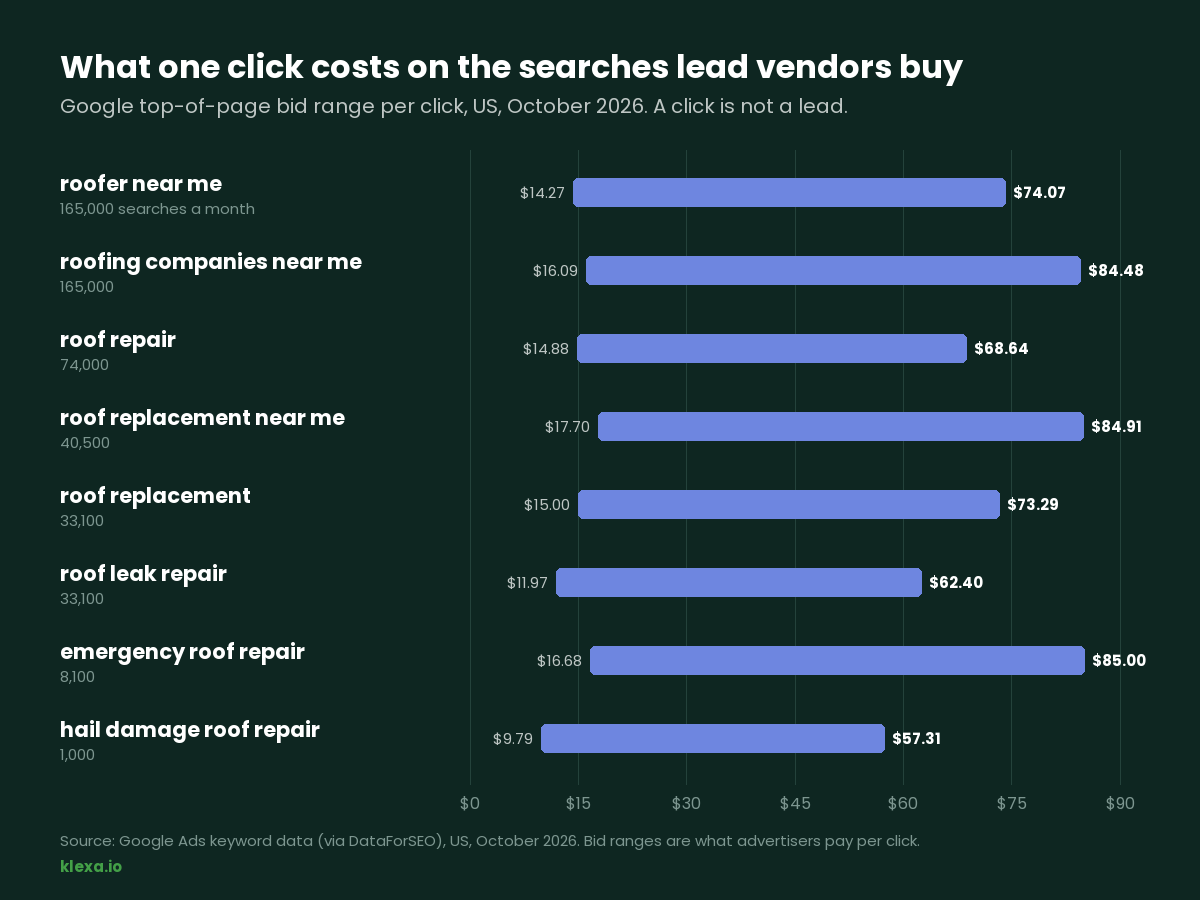
Notice two things. A click is not a lead. Most clicks don’t call, so a $30 click can easily become a $200 lead. An “exclusive” vendor charging $150 only makes money if their account is tighter than yours.
And a repair click costs about the same as a replacement click, while the jobs are worth ten times different. That’s why a good account runs separate campaigns for repair, replacement and storm work.
It’s also why a vendor who sells you “roofing leads” with no job-type filter is selling you a lottery ticket. We go deeper on click prices in our roofing PPC guide.
The only number that matters: cost per booked roof
Cost per lead is the number roofing lead generation companies quote. Cost per booked roof is yours.
The formula fits on a napkin. Everything you paid the channel in 90 days, membership and ad spend included, divided by the roofs you signed from that channel. Never blend channels. A blended number hides the one that’s losing.
Here’s a worked example with made-up inputs. Every figure below is an assumption, chosen to sit inside the public ranges above. Replace them with your own.
| Source | Price you pay | Who else gets it | Roofs signed per 10 leads | Cost per booked roof |
|---|---|---|---|---|
| Shared marketplace lead (assumed $60) | $60 | 3 other roofers | 1 | $600, before the annual fee |
| Same shared lead, slower follow-up | $60 | 3 other roofers | 0.5 | $1,200 |
| Exclusive bought lead (assumed $150) | $150 | Nobody | 2.5 | $600 |
| Your own Google Ads, untuned ($30 a click, 1 lead per 8 clicks) | $240 | Nobody | 3.3 | $720 |
| Your own Google Ads, tuned ($30 a click, 1 lead per 5 clicks) | $150 | Nobody | 3.3 | $450 |
Swipe the table sideways to see every column.
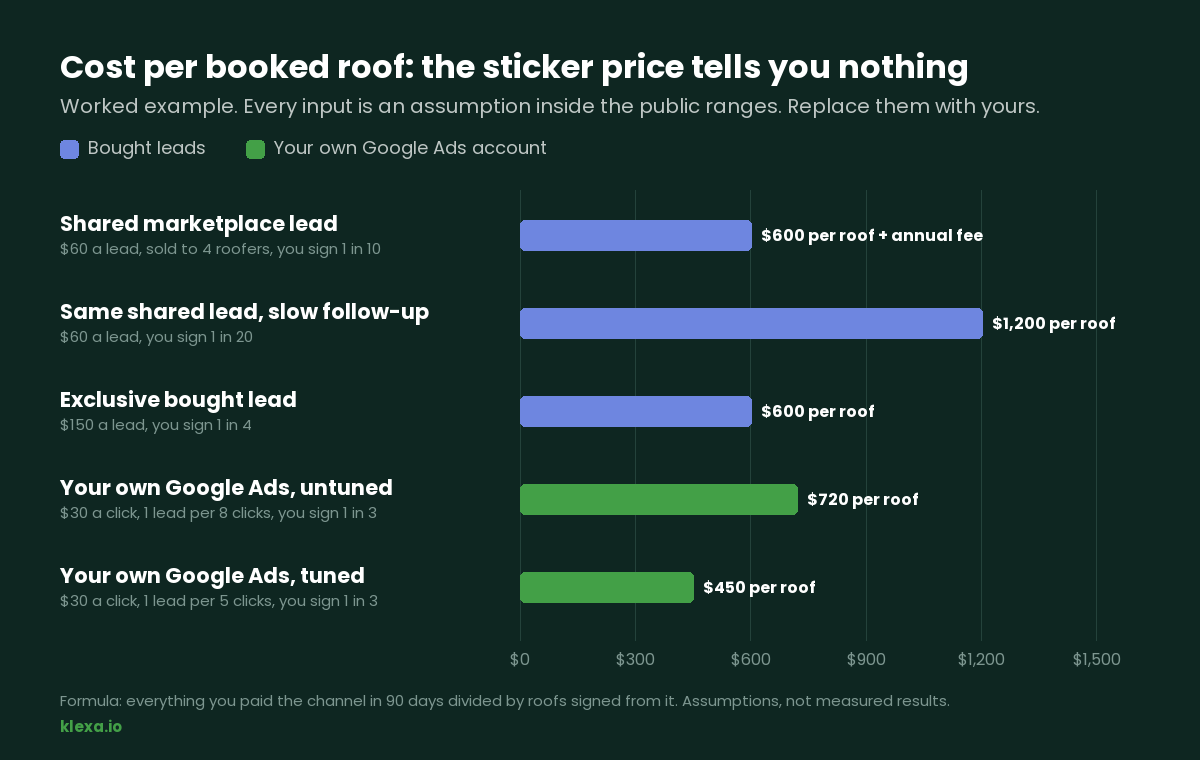
Read the table honestly and two things jump out.
First, the sticker price tells you nothing. The $60 lead and the $150 lead land at the same $600 a roof, and the $60 lead gets worse the moment your follow-up slips, because three other roofers are calling the same homeowner.
Second, your own ads don’t automatically win. The untuned row loses to the exclusive vendor. What’s different is that on your own account, every improvement is yours to make and yours to keep.
Block the job seekers and the “roofing materials” searches, send replacement clicks to a replacement page, count calls as conversions, and the lead rate moves. The tuned row is the same budget with the junk removed.
On a vendor’s account, that improvement is their margin, not your savings.
Exclusive roofing leads vs shared leads: the race you’re in
The contractor reports Remodeling Marketing collected put a standard Angi lead in front of three to eight contractors, and roofing leads reportedly as high as 16. Thumbtack shows each project to four or five pros.
Those are reports, not audits, but they match what roofers say about roofing lead generation companies in every forum thread on the subject.
Some shared leads never asked for a roof at all. A gutter contractor on ContractorTalk described how it works: the marketplace cold-calls homeowners offering four free quotes, the homeowner says sure, and four contractors pay for a “lead” that was never in the market.
A shared lead is a race, and the start gun fires when the form submits. A Harvard Business Review audit of 2,241 US companies, cited by ActiveProspect in its roofing lead guide, found that firms contacting a web lead within an hour were about seven times as likely to qualify it as firms that waited even one hour longer.
The contractors who like Thumbtack say the same thing from the other direction. Quote within minutes, before the request hits its limit of roughly five quotes, or don’t bother.
Now picture who buys shared leads. It’s the owner-operator who was searching “roofing leads near me” at 10 pm because the crew is idle next week. That same owner is on a roof at 2 pm when the lead lands. Shared leads punish exactly the roofer most likely to buy them.
“Exclusive” fixes the race, if the word means something. Make the vendor define it in writing: sold once, never resold after 30 days, never recycled into a “warm” list next quarter. If they won’t put that in the contract, the lead isn’t exclusive. It’s just more expensive.
Nine questions to ask before you buy roofing leads
Most of the horror stories about roofing lead generation companies in the contractor forums come down to skipping three or four of these. Ask all nine, get the answers in writing, and the bad vendors filter themselves out.
- What counts as a billable lead? Wrong numbers, job seekers, people outside your service area, a hang-up after four seconds. Which of those do you pay for? And if the pitch is “ten guaranteed leads,” what does guaranteed mean, and is the refund cash?
- What’s the dispute window, and do credits come back as cash or as platform credit? Contractors report Thumbtack gives 45 days and refunds as credits, so a bad lead buys you another lead, not your money. One countertop contractor on ContractorTalk walked away from a 12-year HomeAdvisor relationship when the policy changed to “if we can’t verify your credit request with the homeowner, you pay anyway.”
- How many contractors receive this lead, and is that number in the contract? “A few” is not a number.
- Can I listen to the call recordings? If you can’t hear the lead, you can’t judge the lead.
- Is my territory exclusive, by ZIP code, in writing?
- Is there a membership or annual fee, what’s the notice period, and what’s the cancellation formula? Angi’s reported $300 to $500 a year on a 12-month term is the kind of thing you find out in month thirteen. A flooring contractor on ContractorTalk signed a deal with a cancellation fee of 35% of the remaining annual balance and found out six weeks in.
- Where does this lead come from? Your ads, your website, a coupon site, a “four free quotes” phone call? Ask to see the ad and the landing page the homeowner saw. If they won’t show you, the lead was scraped or bought in bulk.
- Whose name is on the phone number and the landing page, and what happens to them when I leave? If the number is theirs, so is every homeowner who saved it.
- Can you show me the consent record for this lead, and do you honor “stop”? Under the TCPA, prior express written consent is the federal floor, and Florida, Oklahoma and Maryland require consent that names each company that will call. Since April 2025 a homeowner can revoke by any reasonable means. A vendor who can’t produce the consent record is handing you their legal problem.
Question seven is the one that changes minds. Most “exclusive roofing leads” are a Google Ads or Local Services Ads account with a different logo on it. Once a roofer sees that, the next question is usually “why don’t I just own that account?”
When buying roofing leads is the right call, and when it isn’t
Roofing lead generation companies aren’t always the wrong call. Three situations where they earn their keep:
- You’re brand new in a market, with no reviews, no rankings and no ad history. Buying leads gets the phone ringing while you build the things that last.
- A crew is idle next week. An idle crew costs more than a bad lead bill.
- Storm overflow. Your own campaigns are capped at their budget, demand is three times normal, and you’ll take extra work at a worse margin for six weeks.
And three situations where they quietly bleed you:
- As your primary pipeline for years. You’re renting your customer acquisition from a company that can reprice it whenever it likes, and your close rate never improves because you never see the data. A marketing speaker on ContractorTalk put it bluntly: the contractors asking him about lead services at trade shows were spending $500 to $1,000 or more a month on them while their own website and Google listing sat empty. That money would have been the down payment on marketing they’d own.
- Buying after the storm instead of being ready before it. Searches for “storm damage roof repair” jumped to 9,900 in July 2026 (Google Ads keyword data, as published on the KLEXA roofing service page). The vendors’ prices rise with that demand. A campaign that already exists just gets its budget raised.
- Shopping for “affordable roofing leads.” The affordable lead is the one that signs. A $25 lead that never answers is the most expensive lead you’ll buy this year. What roofing marketing actually costs has the wider budget picture.
Roofing leads for contractors who want to own the pipeline: Google Ads first
The best lead generation for roofing company owners who are done renting is the pipeline roofing lead generation companies would otherwise run for you. It’s the same Google auction, with the markup removed and the data kept.
Owning it looks like this. The Google Ads account is in your name, and so is the card on it. The tracking number is yours, so every homeowner who saves it saves you. The landing page is yours.
The search-terms report, the single most valuable file in roofing marketing, is yours to read. It tells you which searches book roofs and which bring tire-kickers and job seekers.
Campaigns are split by job type, so a $900 leak repair and a $15,000 replacement don’t fight over one budget. Calls are counted as conversions, because most roofing leads phone in. Junk gets blocked with negative keywords every week, and the budget moves toward what books.
Local Services Ads run alongside, pay per lead, for the homeowners who click the Google Guaranteed badge. We compared the two in Google Ads vs Local Services Ads.
KLEXA’s roofing service is set up exactly this way, and the pricing is built around the number this article is about. There’s no management fee until the account books you a job. Not a click, not a form, a job on your calendar.
There’s no contract, just 30 days’ notice. You own the Google Ads account, the tracking and the data. Every call the ads bring in is yours alone, never shared with other roofers and never sold on. And once the ads are booking work, local SEO is included at no extra cost.
The catch, because there’s always one. Clicks cost what Google’s table above says they cost, so this needs a real budget. It needs a page that turns clicks into calls, and someone answering the phone when they come.
And it takes two to four weeks of data before the account settles into qualified roofing leads at a cost you can plan around. Nothing about it is instant, which is exactly why roofing lead generation companies can sell “leads this week.”
If you want the best roofing lead generation on a budget that can’t fund ads yet, build the free layer first: Google Business Profile, reviews after every job, a referral ask. Our build-order guide to how to get roofing leads walks through that in order.
Run the 90-day test on every lead source
Stop arguing about vendors and measure them.
Tag every lead with its source in your CRM or a spreadsheet, the day it lands. Count signed roofs from each source, not leads. After 90 days, divide what you paid each source by the roofs it signed. Compare that to your profit on an average roof.
Keep what clears the bar. Cut what doesn’t, whoever’s logo is on it, roofing lead generation companies and Google alike. A call-tracking tool makes the tagging automatic; we wrote an honest take on CallRail if you’re picking one.
The trap to watch for: on shared leads, cost per lead and cost per booked roof move in opposite directions. The cheaper the lead, the more roofers it was sold to, and the lower your odds. Judge the roof, never the lead.
Questions roofers ask about roofing lead generation companies
How much do roofing leads cost?
Service Direct publishes $85 to $550 per exclusive roofing lead. Contractor reports gathered by Remodeling Marketing put Angi at $15 to $85 a lead plus a $300 to $500 annual membership, and Thumbtack at $25 to $75. Generating your own through Google Ads means paying $12 to $85 a click (Google Ads keyword data, US, October 2026) and turning clicks into calls yourself. The only comparable number across all of them is cost per booked roof.
Are roofing lead generation companies like Angi worth it?
Sometimes. Roofing lead generation companies are worth it when you’re new in a market, when a crew is idle next week, or when storm demand outruns your own campaigns. They stop being worth it when they’re your main pipeline, because you never see the data that would lower your cost per roof, and the vendor can raise prices whenever it likes. Run the 90-day test and let the number decide.
What are the best roofing leads?
A homeowner who searched for a roofer in your area, clicked your ad or your listing, and called you alone. Nobody else has the number. That lead closes faster than anything a marketplace sells, because there’s no race. Exclusive bought leads come second, shared leads last, and the gap shows up in close rate, not in price.
Can I get free roofing leads?
Yes, and they cost time instead of money. A complete Google Business Profile, a review request after every job, and a referral ask to every happy customer produce free roofing leads for years. Anything a vendor calls free is a trial, and the meter starts the week after.
Should I buy roofing leads or run Google Ads?
Buy from roofing lead generation companies to fill a gap this week. Run your own ads to build something you keep. Most roofers who grow do both for a while, then let the owned side take over as the data makes it cheaper. Measure both the same way: total spend divided by roofs signed, per channel, over 90 days.
The bottom line
Roofing lead generation companies sell you a Google Ads account with someone else’s name on it and a margin on top. That’s not a scam. It’s a service, and in a slow month or a new market it can be the right one.
Just buy it with your eyes open. Ask the nine questions. Tag every lead by source. Count roofs, not leads.
And if you’d rather see what that same auction costs when the account is yours, bring your service area to a 20-minute call. You’ll hear which roofing searches book jobs in your market and what a booked roof would cost you to win.