
Ask a room of HVAC owners about their last marketing agency and you will not get a debate. You will get a queue.
The complaints are remarkably consistent across trade forums, contractor groups and Reddit threads, and they are not really about ads. They are about a gap between what an HVAC marketing agency reports and what shows up on the schedule board. One HVAC owner put it plainly in an r/PPC thread: most agencies optimise for form fills rather than actual booked jobs, which is why you end up paying for leads that never convert to revenue.
That sentence is the whole problem in one line. Everything below is a variation of it, and every one of them shows up in HVAC lead generation accounts that look healthy from the dashboard.
This is a guide to the HVAC marketing agency complaints that actually recur, what causes each one, and what to demand from an HVAC marketing agency before you sign anything. KLEXA has rebuilt enough contractor accounts to know which of these are genuine agency failures and which are the owner’s own tracking gaps wearing an agency costume, and the difference matters when you are deciding whether to fire someone.
Complaint 1: “I’m paying for leads, but I don’t know if any of them booked”
This is the number one complaint, and it is the one every other complaint hides inside. A contractor marketing account on LinkedIn put it the same way, saying the most common thing they hear from HVAC companies is that they are paying for leads without knowing what happened next.
Here is the mechanism. Google Ads optimises toward whatever you tell it a conversion is. If a conversion is defined as “form submitted” or “clicked the phone number”, then the algorithm gets very good at producing form submissions and phone clicks. It has no idea which of those became a $6,000 system replacement and which was a homeowner asking whether you service their brand of thermostat.
So the agency’s report says 47 leads. Your dispatcher says it was a slow month. Both are telling the truth.
The fix is not a better report. It is a different definition of conversion, one that counts calls that actually connected and lasted long enough to be a real conversation, and ideally one that sends the booked job back into the ad account so bidding learns from revenue instead of from form fills. That is a build task, not a reporting task, which is why changing agencies rarely fixes it on its own.
Complaint 2: Your HVAC marketing agency never set up tracking properly
An HVAC digital marketing community on Reddit describes seeing HVAC companies waste budget by not tracking forms or calls at all. That matches what turns up in most accounts handed over for a second opinion.
The usual state of an HVAC account that “isn’t working”:
- Calls are counted when someone taps the number, not when the call connects and lasts past a threshold
- The same lead is counted twice, once as a form and once as a call, so the report double counts
- Conversions fire on the thank-you page load, including on refreshes
- Nothing distinguishes a maintenance-plan enquiry from an emergency no-cool call
Measurement is the first thing to judge, before performance. If the numbers are wrong, every decision built on them is wrong too, and a campaign that looks like a failure may be producing work nobody is attributing. Our write-up on call tracking for service businesses covers how call data gets connected back to the ad that caused it, and GA4 for service businesses covers the analytics side.
Worth being blunt about one consequence: fixing tracking usually makes your numbers look worse before they look better, because the fake conversions disappear. Any agency that promises the reported figures will improve immediately after a tracking rebuild is telling you what you want to hear.
Complaint 3: Shared leads that three other companies already called
This complaint gets aimed at agencies but usually belongs to lead resellers. In an r/HVAC thread about a marketing service, an owner described lead companies selling overpriced leads shared with ten other people. In another r/HVAC thread on getting more work, the top advice was that paying a lead marketplace when you are starting out is the biggest waste of money and a gamble.
The distinction matters because it changes what you should buy:
- A lead marketplace sells you a contact. Often the same contact it sold to competitors minutes earlier. You are one of several callbacks, and the homeowner is comparing on price by the time you reach them.
- An HVAC PPC or marketing agency builds demand that arrives at you directly. The call comes to your number, from your ad, and nobody else is dialling that homeowner.
If an agency is reselling shared leads under a management fee, you are paying twice for the weaker version. Ask directly whether leads are exclusive to you and whether the phone number in the ad is yours.
Complaint 4: The HVAC marketing agency report measures activity, not money
Impressions up. Click-through rate up. Cost per click down. Nothing on the board.
Those three metrics can all improve while the account gets worse, because cheaper clicks often means less qualified clicks. An HVAC account bidding its way into cheap traffic is usually drifting toward people searching for DIY fixes, part numbers and price comparisons rather than homeowners with a dead system in August.
A report worth reading answers four questions in this order: how many calls connected, how many became booked jobs, what each booked job cost in ad spend, and which search terms produced them. That third number is your real cost per lead, once the calls that never booked are stripped out of it. If the monthly report leads with impressions, it is a document designed to look like work.
Complaint 5: The account is on autopilot and the search terms prove it
The search terms report is the honest record of what you actually paid for. In neglected HVAC accounts it fills up with searches for jobs you do not want and cannot profitably serve: how-to repairs, part lookups, warranty questions, job seekers, and people in towns outside your service radius.
Every one of those is a click you paid for. HVAC advertising is not cheap either. Google’s own top-of-page bid ranges for “ac repair” run from $12.84 to $87.87, and for “furnace repair” from $9.78 to $64.70, according to Keyword Planner data for the United States pulled in August 2026. At the top of those ranges, twenty wasted clicks is a four-figure mistake.
Negative keyword work is unglamorous, ongoing, and the single clearest signal of whether anyone is actually inside your account. Our guide to negative keywords explains what the discipline looks like. If your agency cannot show you what they added last month, the answer is nobody has been in there.
Complaint 6: The budget never moves, but HVAC demand swings violently
This is the complaint owners feel but rarely name, and it is measurable.
Here is US search demand across a full year, from Keyword Planner, August 2026:
| Search term | Lowest month | Highest month | Swing |
|---|---|---|---|
| ac repair | 165,000 (Dec 2025) | 673,000 (Jul 2026) | 4.1x |
| furnace repair | 60,500 (Jun 2026) | 450,000 (Jan 2026) | 7.4x |
| heating repair | 5,400 (Apr 2026) | 74,000 (Oct 2025) | 13.7x |
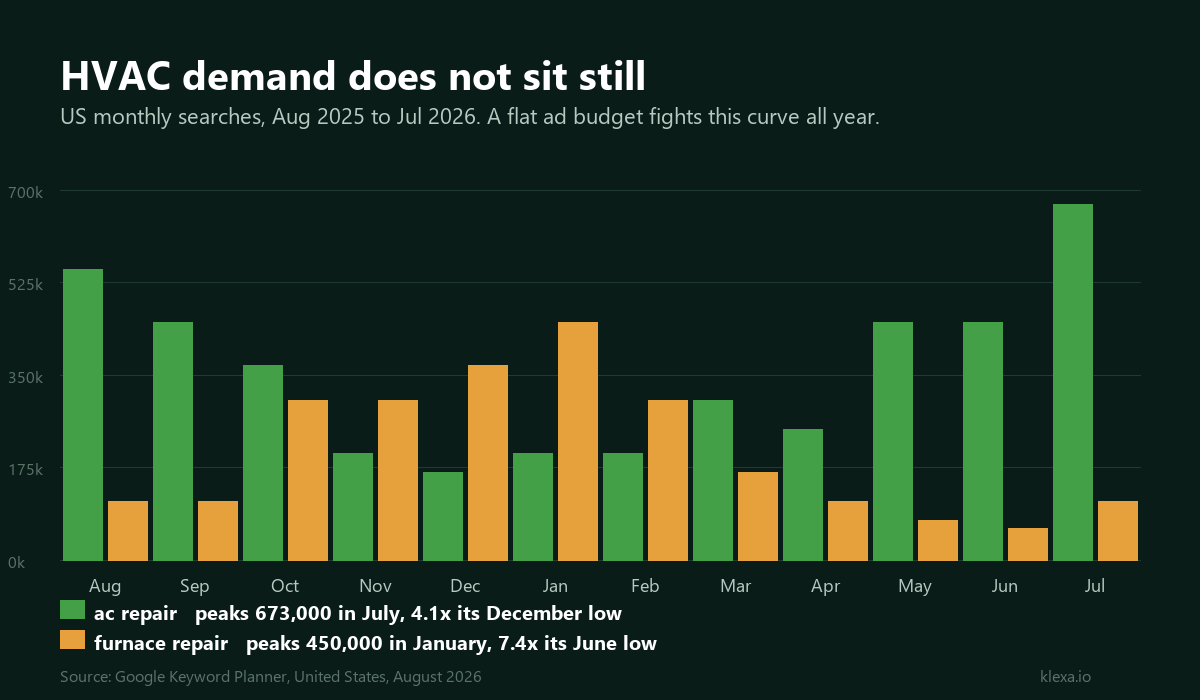
Furnace demand multiplies by more than seven between June and January. Cooling demand quadruples between December and July. A flat monthly budget across that curve means you are overpaying for attention in the quiet months and running out of budget in the exact week the phones should be ringing off the hook.
The two peaks are also opposites. A heating-led shop and a cooling-led shop should not be running the same budget calendar, and neither should be running a flat one. If your agency has never proposed changing your spend in line with that curve, they are managing a spreadsheet, not a season.
Complaint 7: The HVAC marketing agency bills from day one
The structural complaint. Twelve-month agreements, sixty to ninety days of “onboarding”, and a management fee charged in full from the first invoice, before a single call has come in.
The owner is carrying all the risk during the period when the agency has produced nothing yet. That is backwards, and it is the reason so many HVAC owners describe agency relationships as something they endure until the contract runs out.
There is a reasonable version of this. Setup genuinely takes work and deserves to be paid for. Conversion tracking, call tracking, campaign structure and landing pages are real build hours. What is not reasonable is charging an ongoing management fee for months before the thing works.
Complaint 8: Nobody will tell you what HVAC advertising actually costs
This one comes from the owner’s side and it is fair. In an r/DigitalMarketing thread about working with HVAC companies, a marketer’s blunt advice was that leads are expensive and if a contractor cannot budget at least $1,500 a month, it is not worth either party’s time.
Run the arithmetic yourself rather than trusting a number from an article, including this one. Every input below is an assumption you should replace with your own:
- Take a $30 click, which sits inside the real bid ranges quoted above
- $1,500 a month buys 50 clicks
- At a 10% click-to-call rate, that is 5 calls
- At a 50% booking rate, that is 2 to 3 booked jobs a month
If those numbers do not clear your cost of acquisition, the budget is the constraint and no agency can fix it with better ad copy. Our Google Ads budget guide works through this properly. This is also the honest reason some HVAC companies should not be running Google Ads yet, and any agency willing to say so is worth more than one that is not.
Complaint 9: Your HVAC marketing agency has no position on Local Services Ads
Most HVAC companies end up running both without a plan for how they interact. Local Services Ads charge per lead and sit above everything. Search charges per click and gives you control over the terms you appear for. They can complement each other or quietly compete for the same homeowner.
An agency should have a position on which channel owns which intent, and should be able to tell you what a booked job costs in each. We compare the two in Google Ads vs Local Services Ads.
What to demand from an HVAC marketing agency before you sign anything
Take this list to the next HVAC marketing agency call. The answers tell you more than the case studies will.
- “Show me how a booked job gets back into the ad account.” If the answer stops at form fills, everything downstream is guesswork.
- “Whose phone number is in the ad, and are these leads exclusive to me?” Separates an agency from a lead reseller.
- “Show me last month’s negative keyword additions.” Proof of presence in the account.
- “What will you change about my budget in January and July?” Tests whether they understand HVAC seasonality at all.
- “What does a booked job cost me right now, and what should it cost?” The only performance number that matters.
- “What am I paying before it produces anything?” Where most of the resentment starts.
- “Who owns the ad account and the tracking if we part ways?” The answer should be you, always.
If you want the diagnostic version of this, our guide to why HVAC lead generation produces leads that never become jobs takes complaint 1 apart in detail, and our guide to why Google Ads is not working walks through the four different failures that all look identical from the dashboard, and our rundown of HVAC marketing agencies, and the mechanics of Google Ads for HVAC if you want the build detail rather than the buying decision covers who does what, including where KLEXA is and is not the right fit.
How KLEXA prices this, and why
The HVAC marketing agency complaints above are mostly structural. They come from an arrangement where the agency gets paid the same whether the phone rings or not. So KLEXA prices it the other way around.
- $1,000 one time to set it up. That covers your conversion tracking and the campaign build. It is real work and it is paid for once.
- After that, no management fee until it books you a job. Not a discount, not a trial. No management fee at all until the work produces a booked job.
- Once you are happy it is working, $1,500 a month. Your local SEO is included at no extra cost, so your HVAC SEO and your paid search stop being two separate invoices that never talk to each other.
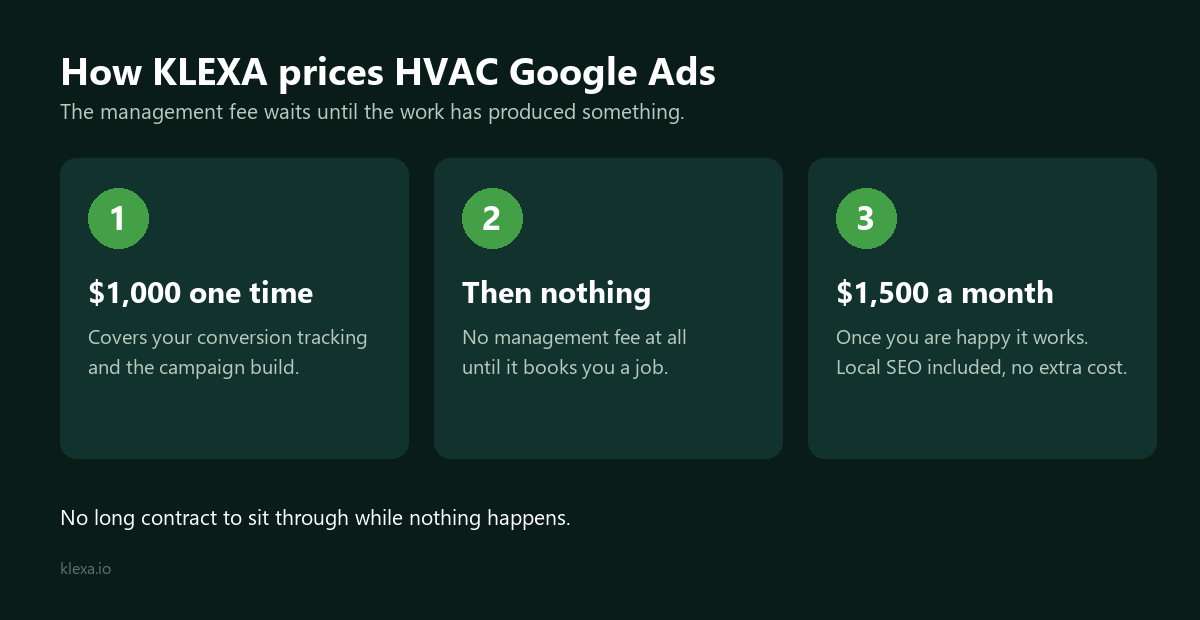
The reason the setup fee exists and the management fee waits is the same reason complaint 1 and complaint 7 keep recurring. Tracking has to be built before anything can be judged honestly, and nobody should be paying a monthly retainer during the period when there is nothing yet to manage.
If that structure sounds like the fix to what went wrong last time, book a call and bring your current numbers. If it does not, take the seven questions above to whoever you talk to next. They work regardless of which HVAC marketing agency you hire.
See our HVAC marketing offer: Google Ads with no setup cost and no management fee until your first booked call.
Questions HVAC owners actually ask
How much should an HVAC company spend on marketing?
Work it from click costs rather than from a percentage rule. Google’s published top-of-page bids for “ac repair” run $12.84 to $87.87 in the United States. At a $30 click, $1,500 a month buys about 50 clicks, which at a 10% call rate and a 50% booking rate is roughly 2 to 3 booked jobs. Those conversion rates are assumptions, so replace them with your own and see whether the result clears your cost of acquisition. If it does not, the budget is the problem before the agency is.
Is it worth hiring an HVAC marketing agency at all?
An HVAC marketing agency is worth it when the constraint is expertise and attention, and not when the constraint is budget. HVAC marketing companies can fix wasted spend, bad tracking and poor campaign structure. It cannot manufacture demand that your budget cannot buy. If your monthly ad budget is small enough that it produces one or two clicks a day, hire nobody yet and fix the budget first.
Why do my Google Ads leads never turn into booked jobs?
Usually because the account is optimising toward the wrong event. If conversions are defined as form fills or phone-number taps, Google will produce more of those regardless of whether they book. Redefining a conversion as a connected call past a duration threshold, and feeding booked jobs back into the account, changes what the bidding learns from. This is the single most common finding when KLEXA reviews an account an HVAC marketing agency has been running for a while.
Are shared HVAC leads ever worth buying?
They fill a schedule gap and they train you to compete on price. The homeowner has usually spoken to two or three companies before you call, so you are negotiating from behind. HVAC owners on trade forums describe lead marketplaces as a gamble and a waste of money for newer companies, and the structural reason is that you never own the relationship or the phone number.
How long before Google Ads produces booked jobs for an HVAC company?
Search intent is immediate, so calls can start in the first week once tracking and campaigns are live. Judging performance is slower. You need enough connected calls to separate signal from noise, which in a normal-sized service area takes several weeks. Be suspicious of anyone promising a stable cost per booked job in month one, and equally suspicious of anyone asking for six months before showing you anything.
Should HVAC companies run Local Services Ads instead of Google Ads?
Most run both. Local Services Ads charge per lead and sit at the very top of the page, which suits emergency intent. Search Ads charge per click and give you control over which terms you appear for, which suits replacement and maintenance intent where the homeowner is comparing. The question to settle is which channel owns which intent, so the two are not bidding for the same homeowner.
What should an HVAC marketing agency actually report each month?
Connected calls, booked jobs, cost per booked job, and the search terms that produced them. Impressions, click-through rate and cost per click are diagnostic details, not results. A report that leads with those four numbers is a report about your business. A report that leads with impressions is a report about the agency’s activity.
Sources named in this article: search volume and top-of-page bid ranges are from Google Keyword Planner, United States, August 2026. Owner quotes are paraphrased from public threads in r/PPC, r/HVAC, r/DigitalMarketing and r/HVACDigitalMarketing, and from a contractor marketing post on LinkedIn.
Same problem, different trade: the New York crane and rigging version of this, with the seven leaks measured from Google’s own data, is in why NY crane and rigging companies are burning money on generic Google Ads.
Same problem, different trade: the dental version of losing control of the search terms report is playing out this month under the AI Max auto-upgrade. See why implant keywords are the worst place to lose match-type control.