
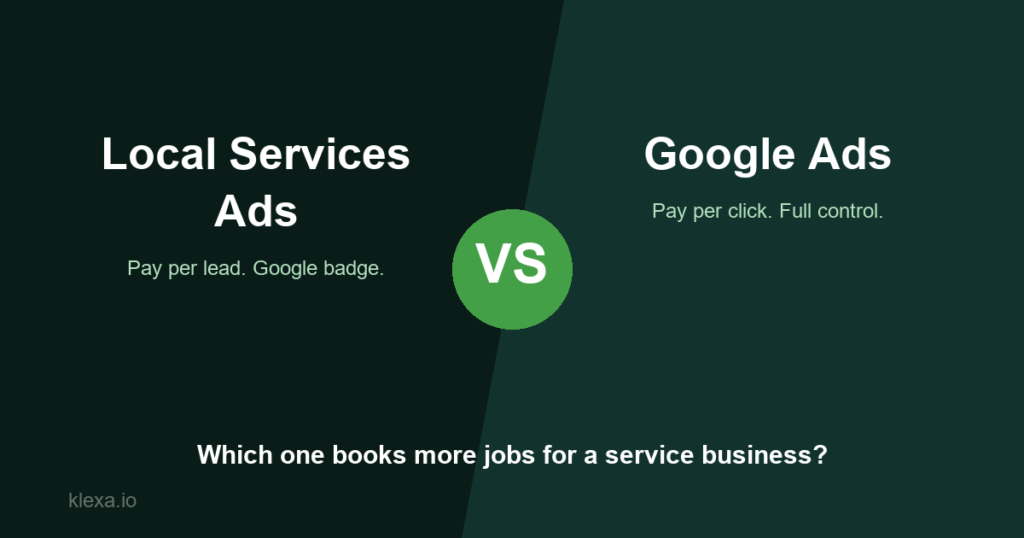
TL;DR: Local Services Ads charge per lead and sit above everything on Google, but give you few levers and cannot be scaled on demand. Google Ads charges per click and scales with your budget. For most service businesses that qualify, run LSAs as the always-on top layer and use Search to control volume and grow.
Updated October 2026: LSAs are moving into Google Ads as Performance Max campaigns with pay-per-lead goals. See what changes.
A roofer asked me last month why he should pay us to run Google Ads when “the Google Guaranteed thing” was already sending him calls for less. Fair question. And the honest answer took the whole call, because these two products get lumped together constantly and they could hardly be more different.
So here’s that whole conversation, written down. What Local Services Ads actually are, what they cost, where they beat traditional Google Ads, where they quietly fall short, and how we split budgets between the two for service businesses.
What are Local Services Ads, exactly?
Local Services Ads (LSAs, the “Google Verified” listings, formerly “Google Guaranteed”) are the boxes at the very top of Google when someone searches for a local service: photo, star rating, green checkmark, phone number. They sit above the regular ads, which sit above the map, which sits above the organic results. Top of the food chain, visually.
Three things make them a different animal from regular Google Ads. You pay per lead, not per click, a lead being an actual phone call or message, not a website visit. You go through background and license screening to earn the Google Verified badge (formerly Google Guaranteed), which tells nervous homeowners Google has vetted you. And there are no keywords, no ad copy, no landing pages. You pick your job types and zip codes, set a budget, and Google decides the rest.
That last part is the whole trade-off, and we’ll come back to it.
What do Local Services Ads cost?
Lead prices vary by trade and metro, but the ranges we see across US service accounts: $15 to $50 per lead for the mid-ticket trades (electrical, garage doors, landscaping), $25 to $80 for plumbing and HVAC, and north of $100 for the big-ticket emergency categories like water damage in competitive metros. Google adjusts lead prices with demand, so storm week costs more than a quiet Tuesday in February.
Compare that with what a well-run Search campaign produces. A plumbing client of ours generated leads at $92 from Google Ads Search, and our crane and rigging client generates them at $197 in a trade where LSAs barely exist. Sometimes LSA leads come in cheaper than Search leads, sometimes the reverse. The real difference isn’t the sticker price. It’s what you can do when the numbers aren’t working, which brings us to the comparison that matters.
2026 update: Local Services Ads are moving into Performance Max
Google is retiring the separate Local Services Ads dashboard. LSA campaigns are moving into Google Ads as Performance Max campaigns with a pay-per-lead goal. US home service categories such as plumbing, HVAC and electrical started moving in August 2026, service-area businesses without a storefront follow in late 2026, and non-US accounts in 2027. Google emails account admins 14 days before an account moves.
What stays the same: you still pay per qualified lead, not per click. The ads still show only on Google Search and Google Maps. There are still no keywords: targeting is by service category and service area. The Google Verified badge carries over for businesses that qualify, and your lead history moves across.
What changes:
- Manual bidding, such as setting a maximum cost per lead, is no longer available, and per-service target CPAs are replaced by one target for the campaign. If your services are worth very different amounts, they need separate campaigns.
- Weekly budgets become average daily budgets, with monthly spend capped at the daily average times 30.4.
- Historical performance reports do not transfer. Download or screenshot your LSA performance data before your account migrates.
- The Better Business Bureau callout is discontinued. Add at least six other structured callouts instead.
For the split described below, the logic holds: LSAs stay the pay-per-lead top layer with few levers, and Search stays the layer you control and scale. The practical difference is that both now sit in the same Google Ads account.
Source: Google Ads Help: Local Services Ads transition to Performance Max campaigns with pay-per-lead goals. Checked 6 October 2026.
The differences that actually matter
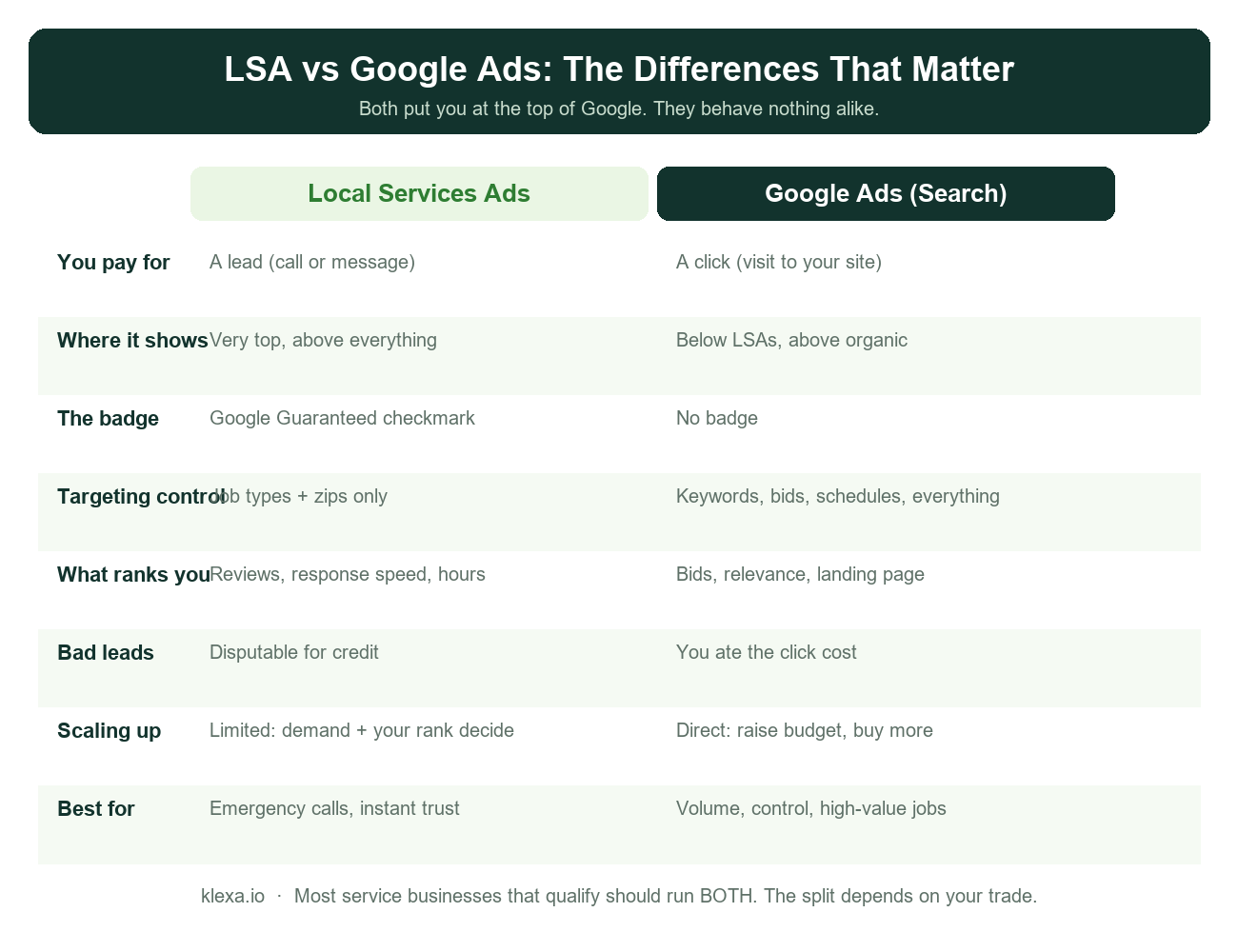
Control is the big one. In Google Ads, if leads are expensive you have levers: tighten keywords, add negatives, change bids, fix the landing page, shift budget to the winning campaign. We’ve written whole guides on cutting junk clicks and setting budgets that work (and a calculator that works out your number). In LSAs there are almost no levers. You can adjust job types, zips, and hours. That’s roughly it. When LSA lead flow drops or quality dips, most owners just… wait.
What ranks you is completely different. Search ranks on bids and relevance, things you can engineer this afternoon. LSAs rank mostly on your review score, how fast you answer the phone, and how often you mark leads’ outcomes. A competitor with 300 reviews and a 15-second response habit will out-rank you regardless of budget. That makes LSAs a slow trust game, not a dial you turn.
Bad leads work differently too. LSA leads that are spam or outside your services can be disputed for credit, which is genuinely nice. In Search, a wasted click is just gone, which is exactly why the negative keyword discipline matters so much there.
And scaling is the quiet dealbreaker. This is the one nobody tells you. When LSAs work, owners naturally want more, and there is no more. Your rank and local demand cap your lead flow, and raising the LSA budget past that ceiling changes nothing. Search is the opposite: if your cost per lead is stable and you’re losing impression share to budget, more money buys more leads, almost linearly. One product has a growth lever. The other doesn’t.
Where LSAs win
Emergency, call-now trades with strong review profiles. A burst pipe at 11pm is decided by whoever’s at the top with a checkmark and answers first. If you’re a plumber, locksmith, or HVAC company with 50+ good reviews and someone who actually picks up the phone, LSAs are close to free money and you should be running them. The badge alone converts anxious homeowners better than any ad copy.
Where Google Ads wins
Everywhere you need control, volume, or selectivity. High-value work (a repipe, a full roof replacement, a commercial contract) where you want to target the exact search and send it to a page built to sell that job. Trades LSAs barely covers, like our crane and rigging client. B2B services. And any business that wants to grow on a schedule instead of waiting for rank. Search is also where proper conversion tracking tells you precisely which searches become booked jobs, data LSAs simply don’t give you.
The answer for most service businesses: both, in this order
If you qualify for LSAs, here’s the sequence we actually run with clients.
First, turn LSAs on and treat them as the base layer. Get screened, get the badge, connect your reviews, and build the phone-answering habit, because response speed is a ranking factor. Let it produce whatever your rank produces. Budget-wise this often lands around 20 to 40 percent of total spend for emergency trades.
Second, put the growth budget into Search. This is where the weekly management work compounds: tracking first, negatives, tight campaigns per service, bids by geography. It’s the layer you control, measure, and scale.
Third, let each do its job. LSAs catch the emergency calls at the top. Search captures everything LSAs miss: the researchers, the high-ticket jobs, the specific services, the areas where your LSA rank is weak. Owners who run both and track honestly usually find they need both numbers to hit their lead targets.
One warning from the trenches: don’t judge either channel without honest measurement. Half the “LSA leads are better” or “Search is a waste” verdicts we hear collapse the moment real tracking goes in and we can see which channel actually produced the booked jobs. It is also the first thing worth asking any agency you are interviewing, which is why it leads our HVAC agency comparison. If you want to check your own setup first, run through our 15-minute Google Ads audit checklist.
The bottom line
LSAs are a vetted, pay-per-lead faucet you don’t control. Google Ads is a machine you do. The faucet is worth having open, and the machine is what grows the business. Run the faucet, build the machine, measure both, and stop treating it as a versus question, because the businesses winning your market quietly run both.
If you’re spending on either right now and can’t say what a booked job costs you from each channel, that’s the first thing to fix, and it takes two minutes to see how your setup scores.
Want this handled for your account? See how Klexa runs Google Ads management for service businesses, with no management fee until the account books you a job.
Not sure where your ad budget should go?
Free Google Ads review call for business owners. Plain English answers, no obligation.
Where do both fit in the bigger picture? Our guide on how to get roofing leads puts LSAs and Search in their build order.